Superhero (also sold as Super Hero) is an isometric 3D arcade adventure by Paul Machacek and Bernie Drummond, released by Codemasters as a budget game in 1988. You play an immortal hero, styled after the thunder god Thor, who must solve a huge labyrinth of puzzle rooms set by the gods or lose his immortality. The Commodore 64 version was converted by Martin Ellis, with music by Steve Barrett.
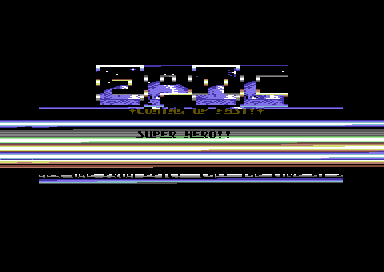
How to start the game: the version on this page is a 1988 crack with two intro screens and a trainer, so it waits for you three times before the game begins. Press START under the game screen and wait about 10 seconds for the EPIC intro (“SUPER HERO!!”), then press Space. Wait until the ZENITH logo has appeared and press Space again. The trainer asks “DO YOU WANT INFINITE LIVES (Y/N)”: press Y or N. On the Codemasters title screen (“Please hit fire to play”) press Ctrl, the fire button of joystick 2. On a phone or tablet, open the Virtual C64 Keyboard (the keyboard icon under the game) for Space, Y and N, and tap the left half of the game screen for fire.
The C64 title screen: “Please hit fire to play” means press Ctrl.
Quick facts
- Game: Superhero (Super Hero)
- Original design: Paul Machacek (code) and Bernie Drummond (graphics), ZX Spectrum, 1988
- C64 conversion: Martin Ellis (code and graphics), music by Steve Barrett
- Publisher: Codemasters, budget cassette, £2.99 on the C64
- Year: 1988
- Genre: isometric 3D arcade adventure / puzzle
- Players: 1
- Controls: joystick in port 2 (cursor keys + Ctrl here), Space to pick up objects
- Other versions: ZX Spectrum (original), Amstrad CPC
About the game
Fate has made you an immortal. To fight the boredom of eternity, the gods and superheroes set each other fiendish puzzles, and now it is your turn. Fail, and the watching deities strip you of your immortality. Venus, the goddess of love, feels sorry for you and has hidden four magical gifts in the complex:
- Power boots let you jump.
- The returning warhammer deals with the monsters and ghouls in the corridors.
- The trans-dimensional bag cancels an object’s size and weight so you can carry it.
- The mystical helmet makes the gods shower you with gifts.
The real goal is to beat five Guardians who block the corridors. A Guardian can only be defeated by capturing his spirit, which is hidden somewhere in the rooms. Each captured spirit throws you into the DeadZone, and surviving it earns a bonus life. Get past all five Guardians and enter the room behind the last one to finish the game.
The first room: a staircase of checkered blocks in front of a carved wall.
How to play
The game alternates between two kinds of areas. The rooms are static isometric puzzles in the style of Batman and Head over Heels: you push blocks to reach higher ledges, build makeshift bridges, ride conveyor belts and time your jumps. The corridors (the outdoor sections) connect the rooms and are full of random monsters. On the C64 these corridors flip from screen to screen instead of scrolling.
Once you wear the helmet, the gods drop extra help in the corridors:
- Teleport keys work the teleports, the shortcuts through the large map.
- Mercury’s winged shoes make you run faster for a while.
- Paralysers clear the corridor monsters.
- Gold buys things from the traders.
- ESP activators are carried to the ESP orbs in certain rooms. The orb then shows the way to the next Guardian’s spirit: green means you are heading the right way, red means the wrong way.
Traders are bodiless creatures with winged ears. Walk into one to trade: gold buys extra lives, paralysers, teleport keys or information, or you can gamble with them. Watch out for the fuzzy energy spheres in some rooms: they home in on you and kill you, unless you jump on top of them. Standing on a sphere also lets you cross deadly floors safely.
Controls
Action C64 On this site Move Joystick in port 2 Cursor keys Fire (start game, jump once you have the boots) Fire button Ctrl Pick up / drop objects Space Space Pause F7 F7
Space and F7 come from the instructions in the crack intro (“Space to pick up objects … F7 to pause”). At the very start you have none of Venus’ gifts, so fire does nothing in the first room until you find the power boots.
Exploring the first room.
Tips
- Find the four gifts first. Without the boots you can’t jump, and without the bag you can’t carry anything.
- Keep gold for the traders: extra lives and teleport keys save a lot of walking on the big map.
- Use the ESP orbs whenever you are lost. Green is the right direction.
- Jump onto energy spheres instead of running away from them.
- On the C64 the exits of the outdoor screens are not always obvious, so try every edge of a screen.
- The trainer’s infinite lives (answer Y) is a fair way to explore the map before a serious attempt.
History and reception
Paul Machacek wrote the game as a tribute to Ultimate’s Knight Lore and Nightshade. Jon Ritman, the coder of Batman and Head over Heels, introduced him to Bernie Drummond, who drew the graphics and turned Machacek’s Norse god into Thor. The working title was Aidacra (“Arcadia” backwards). Codemasters disliked it and renamed the game Super Hero. Machacek later showed the game to Tim and Chris Stamper, which got him a job at Rare. (Source: Retro Gamer #197, “The Making Of: Super Hero”.)
The Spectrum original was released in 1988 for £1.99, followed by the Amstrad CPC and C64 versions. Reviews varied a lot. On the Spectrum, Sinclair User gave 76%, Crash 68% and Your Sinclair 7/10; Amstrad Computer User gave the CPC version 80% (“Batman minus £8 equals Superhero”). Zzap!64 was far harsher on the C64 version in issue #47 (March 1989): 43%, calling it “a dull Knight Lore clone”. Retro Gamer later noted that the C64 port draws its stretched graphics faster than the other versions and praised its “superb” tunes. The game was also included on the Codemasters compilations Quattro Super Hits (1990) and Smash 16 (1993).
The first intro: press Space here.
About this version
The file on this page is the “Superhero +” crack by the groups Epic and Zenith, released on 14 December 1988: crack and trainer by Steve of Zenith, imported to the USA by Candyman of Epic. That’s why you see two intro screens and a trainer question before the Codemasters title screen. The trainer offers infinite lives.
The trainer question: press Y or N.
FAQ
Can I play Superhero (Codemasters) online?
Yes. Press START on this page. The game runs in the browser emulator, but this cracked version shows two intros and a trainer question first: press Space, wait for the ZENITH logo, press Space again, answer Y or N, then press Ctrl on the title screen.
Why does the game stop at the “SUPER HERO!!” screen?
That is the EPIC crack intro, and it waits for the Space key. Press Space, and press Space again on the ZENITH intro that follows. On a phone, use the Virtual C64 Keyboard button under the game.
Who made Superhero for the Commodore 64?
The game was designed by Paul Machacek (code) and Bernie Drummond (graphics) and published by Codemasters in 1988. Martin Ellis made the C64 conversion and Steve Barrett wrote the C64 music.
What are the controls of Superhero on the C64?
A joystick in port 2 moves the hero (cursor keys on this site) and fire is Ctrl. Space picks up and drops objects, and F7 pauses the game.
How do you finish Superhero?
Collect Venus’ four gifts (boots, warhammer, bag and helmet), then capture the spirits of the five Guardians. Each spirit sends you to the DeadZone. Beat all five Guardians and enter the room behind the last one.
Is this the same game as the 1985 “Super Hero” type-in?
No. Super Hero (1985) is a short maze game by James C. Hilty, published as a type-in listing in Ahoy! magazine. Superhero by Codemasters is the 1988 isometric adventure on this page.
Related games
- Knight Lore, the Ultimate classic that inspired Superhero
- Batman (1986 Isometric), Jon Ritman and Bernie Drummond’s first isometric game, converted to the C64 in 2026
- Spindizzy, another isometric puzzle classic
- Super Hero (1985, Ahoy!) and Superhero! by Stuart A. Cook, two other C64 games with the same name
- More Codemasters games
Credits: design and Spectrum code Paul Machacek, graphics Bernie Drummond, Spectrum music Guy Stevens, C64 conversion Martin Ellis, C64 music Steve Barrett, © Codemasters 1988. Sources: GameBase64, Spectrum Computing, CSDb, Zzap!64 #47, Retro Gamer #197.