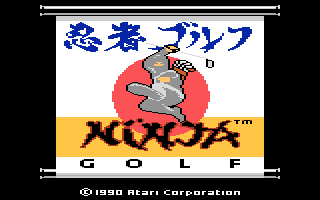
Ninja Golf is a single-player Atari 7800 game released by Atari in 1990, combining golf with side-scrolling martial-arts action. Its premise makes the combination literal: a ninja’s final test after years of training is to survive nine holes of a decidedly hostile golf course. Instead of treating the walk between strokes as an uneventful transition, the game turns it into a running battle. The unlikely meeting of sports and combat became its defining feature, giving one of the console’s late commercial releases an identity that remains immediately recognizable.
Each hole alternates between planning a golf shot and traveling to the ball. A small overhead view in the lower part of the screen shows the course and helps the player choose a destination, while the larger action view follows the ninja’s journey. Unlike a conventional golf game such as Golf, the route to the next stroke has consequences beyond positioning. Sending the ball toward a hazard can mean having to fight through that terrain. The sporting decision and the action sequence therefore belong to the same challenge, even though each uses a different perspective.
The course is populated by enemy ninjas and hostile creatures rather than peaceful spectators. Frogs, snakes and sharks appear among its threats, with sand and water introducing their own dangers. The ninja can jump, crouch, kick and throw stars, balancing close combat against attacks from a safer distance. Moving to the ball is thus more than a race to the right edge: surviving depends on recognizing approaching enemies and choosing when to engage or avoid them. The absurd setting is also functional, turning familiar golf hazards into places with distinct combat risks.
Reaching the green replaces ordinary putting with a battle against a fire-breathing guardian. The ninja throws stars at its mouth while avoiding its attacks, and defeating it allows the round to continue. Scores reward both fighting and efficient golf: reaching the green in fewer strokes earns a better golfing bonus. The nine-hole course includes par-three, par-four and par-five holes, while four selectable difficulty settings—Easy, Normal, Hard and Kamikaze—alter the number and toughness of opponents. Completion demands consistency across both parts of the game rather than mastery of one isolated skill.
Bonus items help sustain the journey. Extra throwing stars replenish ranged attacks, health items repair damage, an extra life extends the attempt, a magic shield grants temporary invulnerability and a warp sends the ninja directly to the green. These rewards provide relief without removing the repeated rhythm of shot, journey and guardian battle. That repetition has divided assessments of the game: AtariHQ’s Matthew Lippart favored the fighting over the golf, while Atari 7800 Forever awarded four out of five and emphasized its humor and fun. Its appeal rests heavily on enjoying the unusual combination as a whole.
Ninja Golf’s historical importance comes from its eccentric inventiveness rather than from establishing a dominant new genre. Released late in the Atari 7800’s commercial life, it shows that an older console’s catalog could still offer an original idea built from familiar forms of play. Its inclusion in the 2022 compilation Atari 50: The Anniversary Celebration brought that idea into a broader account of Atari’s history. Preserved alongside more conventional sports and action games, it records a playful willingness to cross their boundaries: a golf course could become a battlefield, and the journey to a small white ball could matter as much as the shot itself.