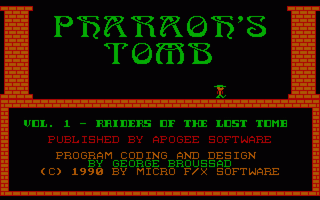
Pharaoh’s Tomb is a single-screen platform game created by George Broussard under the Micro F/X name and published by Apogee Software for MS-DOS in 1990. The player controls Nevada Smith, an archaeologist and adventurer whose name and appearance openly parody Indiana Jones. Smith enters an Egyptian pyramid in search of the legendary pharaoh’s tomb and evidence of his discovery, but must first survive a succession of chambers filled with hostile creatures and ancient traps.
Each level occupies a single screen and generally requires Nevada to collect the necessary keys before reaching the exit. He can run, jump and throw a limited supply of spears at enemies, while moving platforms and elevators provide access to otherwise unreachable parts of the chamber. The dangers include spikes, moving obstacles and stone blocks that fire projectiles when the hero passes in front of them. Contact with an enemy or trap kills Nevada instantly, making observation, route planning and accurately timed movement essential.
Coins, masks, additional spears and other bonuses are hidden throughout the pyramid. Collecting one hundred coins awards an extra life, while five masks provide a substantial score bonus. Some bricks conceal points when struck from below, and special objects can freeze enemies or alter parts of the level. The game also contains deliberately placed dead ends from which escape is impossible, forcing the player to restart or restore a saved position. Fortunately, progress can be saved at the beginning of any level.
Pharaoh’s Tomb comprises four episodes of twenty levels each: Raiders of the Lost Tomb, Pharaoh’s Curse, Temple of Terror and Nevada’s Revenge. In accordance with Apogee’s shareware model, the complete first episode was distributed freely, while the remaining three had to be purchased. The game uses Broussard’s FAST engine—short for Fluid Animation Software Technology—which produces comparatively smooth movement within the restrictions of four-colour CGA graphics. A related 80-level commercial edition was also distributed under the title Pharaoh’s Pursuit.
The colourful but limited presentation and basic PC-speaker effects clearly reflect the game’s age, while broad collision boundaries can make some deaths appear unfair. Its later stages also rely heavily on memorisation and trial and error. Nevertheless, the compact rooms contain a respectable variety of traps and navigational puzzles, and Computer Gaming World praised both the animation and imaginative level design. Pharaoh’s Tomb remains an interesting example of Apogee’s early shareware period and was followed in 1991 by Arctic Adventure, which brought Nevada Smith and the FAST engine to a new setting.