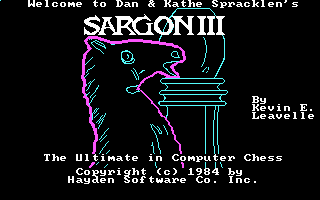
Sargon III is a computer chess program developed by Dan and Kathe Spracklen and published by Hayden Software. First released for the Apple II in 1983, it was subsequently converted to the Commodore 64, Atari 8-bit computers, IBM PC, Macintosh, Amiga and Atari ST. Although its name identifies it as the successor to Sargon II, it was not merely an updated version of the earlier program: the chess engine was rewritten from the ground up, with the intention of producing faster and stronger play.
The program offers nine playing levels, each available in easy and hard modes. At the lowest setting, the computer normally responds within a few seconds, while the highest level can continue calculating without a fixed time limit. Players may compete against the computer or use the program to conduct a game between two human opponents. Additional functions include requesting a suggested move, forcing the computer to move immediately, taking back moves, changing sides, editing a position and saving a game for later continuation.
Sargon III presents the board from a conventional two-dimensional overhead perspective. The precise controls and graphical appearance vary between platforms: some editions accept moves through typed coordinates or a joystick, while versions for systems equipped with a mouse allow pieces to be selected directly on the board. The program also records the moves of the current game and can replay them. Its presentation is restrained compared with later titles such as Battle Chess, but the clearly arranged board and extensive playing options make it considerably more than a basic chess opponent.
One of its most notable educational features is a library of 107 complete historical games played by leading chess masters. These matches can be replayed and studied move by move, giving the software an additional purpose beyond simply playing against the computer. The engine also contains an opening repertoire and introduced more sophisticated programming techniques than its predecessors, including quiescence search and a transposition table. These improvements helped it avoid some elementary tactical errors and use the limited processing power of contemporary home computers more efficiently.
Versions of Sargon III competed in the 1984 World Microcomputer Chess Championship. The Apple II edition finished with four points from seven games, the Macintosh version scored 3½ points and the IBM PC version scored 2½. The Macintosh conversion was also historically notable as the first third-party executable software produced for the new computer. Although its graphics became dated as chess programs grew more elaborate, Sargon III remained an important and technically accomplished title. An enhanced development of its engine was later marketed as Fidelity Chessmaster 2100, while the separately released Sargon 4 and Sargon V continued the series under new publishers.