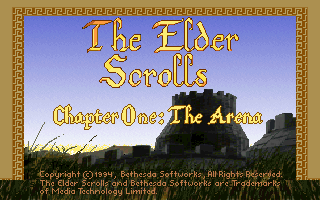
The Elder Scrolls: Arena is a single-player action role-playing video game developed and published by Bethesda Softworks for MS-DOS on March 25, 1994. It introduced The Elder Scrolls series and its fantasy setting, the continent of Tamriel. The adventure allows the player to visit its different provinces, explore settlements and wilderness, and pursue a quest to rescue an imprisoned emperor. A first-person viewpoint and real-time combat combine traditional character statistics with direct exploration of a three-dimensional environment.
Character creation determines the adventurer's race, sex, attributes and profession. Eighteen classes include warriors, spellcasters, thieves and combinations of these roles; a class can be selected directly or suggested through a questionnaire. These choices affect equipment restrictions and magical abilities. Melee attacks are performed by holding the right mouse button and moving the mouse in different directions, while spells are selected through the interface. At the Mages Guild, the spellmaker allows effects to be combined into custom spells, balanced against the magical energy needed to cast them.
Tamriel combines procedurally generated content with deliberately designed locations. Towns contain shops and other services, while the surrounding wilderness offers farms, inns, crypts and further places to investigate. The main story includes seventeen specially designed quest dungeons. Travel between settlements is handled through the continental map: the wilderness around one town is not a continuous landscape connecting every city on foot. This distinction explains how Arena represents an entire continent within the technical limitations of its original DOS release.
The day and night cycle affects exploration: shops close, streets empty and hostile creatures can appear after dark. Inns provide safe accommodation, whereas camping in dangerous areas risks interruption by enemies. Townspeople and innkeepers offer rumours, directions and smaller assignments, including deliveries and dungeon expeditions. These activities supply money and experience without requiring immediate progress through the main story. The opening dungeon can be particularly unforgiving, since an inexperienced character has little equipment and limited health. Better supplies, higher levels and familiarity with the game's systems gradually make survival more manageable.
The story begins in the year 389 of the Third Era. Imperial Battlemage Jagar Tharn betrays Emperor Uriel Septim VII, imprisoning him and General Talin Warhaft in another dimension before magically assuming the ruler's appearance. Tharn kills his apprentice, Ria Silmane, who witnessed the conspiracy, and replaces the imperial guards with demonic servants. The player character, an associate of Warhaft, is left in the Imperial dungeons. Ria nevertheless appears as a spirit, explains the betrayal and helps the prisoner escape through a magical Shift Gate to another province. She subsequently provides guidance through dreams.
The principal objective is to recover the eight scattered pieces of the Staff of Chaos, the artefact Tharn used to banish his victims. Ria supplies leads, but discovering a dungeon's name does not automatically reveal its location. Local inquiries and preliminary tasks often require exploring another dungeon before the actual hiding place can be found. The search therefore links journeys through Tamriel's provinces with a succession of underground expeditions, while leaving room for optional adventures and character development between the major stages.
Reassembling the staff is insufficient to defeat Tharn because its power has been transferred into the Jewel of Fire, which also protects his life force. The final expedition leads beneath the Imperial Palace, through hostile forces to the chamber containing the jewel. Bringing the staff into contact with it ends Tharn's rule and frees the emperor and Warhaft. The restored ruler rewards the adventurer with the title of Eternal Champion. In the series' chronology, this restoration occurs in 399 of the Third Era, ten years after the betrayal.
Arena established Tamriel as a setting in which a central story could coexist with independent travel, character development and dungeon exploration. Its procedural settlements, mouse-directed swordplay and demanding opening distinguish it from later entries, while custom spells and the freedom to postpone the main quest already express ideas the series continued to develop. Bethesda followed it with Daggerfall in 1996 and made Arena available as a free download in 2004 for the series' tenth anniversary. It remains the starting point of The Elder Scrolls, with an unusually broad geographical scope for a role-playing game of its period.