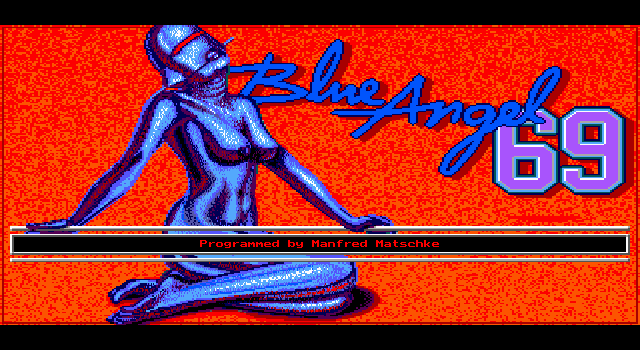
Blue Angel 69 is a puzzle video game developed by micro-partner Software GmbH and published by Magic Bytes in 1989 for multiple home computer platforms including MS-DOS, Amiga, Atari ST, and Commodore 64. The game’s core mechanics are derived from the earlier logic title Maxit, where two players alternately select tiles from a numbered grid under movement restrictions to accumulate higher scores. Blue Angel 69 combines this strategic framework with an adult-oriented aesthetic featuring illustrated female android characters revealed as the board is cleared, placing it within a niche subgenre of late-1980s European puzzle games that married logical gameplay with thematic visual rewards.
Gameplay in Blue Angel 69 takes place on an 8×8 grid of tiles marked with positive and negative values. Two contestants—either a human and a computer opponent, or two human players—take turns moving a marker and selecting tiles. One player is restricted to horizontal movement, while the other is restricted to vertical movement; this alternating constraint forces strategic planning to collect the most high-value tiles and to steer the opponent toward negative values. The game ends when no legal moves remain, and the player with the highest cumulative score wins the round.
Beneath the numbered grid lies a hidden image of a stylized female android. As players take tiles during successful play, sections of this image are progressively revealed. The artwork is presented in a pixel art style consistent with the technical limitations of 8- and 16-bit systems, and while it is suggestive, it depicts fictional gynoid figures rather than real human models. Versions across platforms—such as Amiga, ST, and C64—are broadly consistent in both mechanics and imagery, though the Amiga port is often considered the most technically polished.
Contemporary reviews of Blue Angel 69 were mixed, typically rating the game in the average range. For example, early European magazine coverage placed the game around the mid-60 % range, noting that the logic puzzle mechanics were straightforward and reminiscent of Maxit, and that the adult thematic layer was relatively minor in terms of gameplay impact. Some reviewers appreciated the head-to-head tactical element and the two-player mode, while others found the single-player experience repetitive over longer sessions.
In retrospective contexts, Blue Angel 69 is mainly regarded as a historical curiosity rather than a widely influential title. Its explicit ties to adult-themed content combined with classic puzzle mechanics illustrate how developers in the late 1980s experimented with blending genre formulas to attract niche audiences. While it did not achieve mainstream fame, the game remains of interest to retro gaming historians and collectors for its distinctive aesthetic and as an example of how Maxit-style logic gameplay was adapted and marketed within themed releases across European home computer platforms.