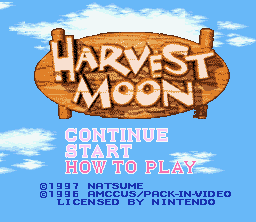
Harvest Moon is a farm simulation video game with role-playing elements, developed by Amccus for the Super Nintendo Entertainment System. It was released in Japan in 1996, North America in 1997 and Europe in 1998. Known in Japan as Bokujō Monogatari, it is the first installment of the series later called Story of Seasons in western territories. The player controls a young man restoring a neglected farm inherited from his grandfather, combining agricultural work with life in a nearby village.
The farm initially requires clearing before useful crops can be planted. Tools allow the player to remove obstacles, prepare soil and water the fields, while selling produce provides money for further development. Vegetables need daily watering to grow; missing a watering delays their development rather than immediately destroying them. The changing seasons affect farming, so the player must plan work around the calendar instead of treating every day as identical.
Livestock introduces a separate routine. Chickens and cows need daily feeding to continue producing, while cows also require attention through talking and brushing, as well as milking. Neglect can cause illness, and an untreated sick cow may die. Chickens left outside are vulnerable to storms and wild dogs. Raising animals therefore involves repeated care as well as buying them, and the player's time must be divided between the fields and animal buildings.
Village life provides activities beyond earning money. The player can talk to residents, attend festivals, forage and develop relationships with five potential marriage partners. Gifts and regular interaction support courtship, while improving the farmhouse is part of preparing for marriage. Farm work consumes stamina, adding another limit to the daily schedule. The original game gives the player two and a half years to develop the farm before the final assessment.
Harvest Moon makes long-term progress emerge from ordinary, repeated tasks: planting, watering, feeding animals and maintaining social ties. Its farming and relationship systems complement each other, allowing success to involve both a productive holding and a family life. The game established the framework followed by later entries in the series, while its fixed assessment period gives this first installment a defined endpoint. Its central challenge is deciding how much attention each part of rural life should receive.