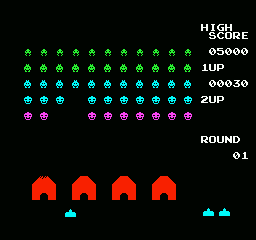
Space Invaders began as an arcade shooting game created by Tomohiro Nishikado and released by Taito in Japan in 1978, with Midway handling its licensed distribution overseas. Its central challenge is to defend the bottom of the screen against a descending formation of aliens and survive long enough to build a high score. The idea is immediately understandable, yet its carefully rising pressure gives it lasting depth. This account describes the original arcade design, whose rules and presentation were adapted in different ways for home computers and consoles.
The player moves a laser cannon horizontally and fires upward. In the original arcade game, fifty-five invaders form five rows of eleven, moving together from side to side and descending whenever they reach an edge. Their projectiles force the player to balance aiming with evasive movement. Losing all available cannons ends the game, but an invasion reaching the bottom ends it even if lives remain. Clearing the formation brings a new wave that begins closer to the player, so success provides only a temporary reprieve rather than a final victory.
Defensive bunkers offer shelter, but their protection is gradually eroded by enemy fire and by the player’s own shots. A position beneath a bunker can therefore be safe while also obstructing a clear line of fire. The occasional mystery ship crossing the top of the screen adds a tempting opportunity for bonus points, competing with the need to control the main formation. As fewer invaders remain, they move faster and the original game’s pulsing sound accelerates with them. The last few enemies can consequently be more dangerous than the full formation, turning apparent progress into mounting tension.
Nishikado drew on earlier shooting games and especially the arrangement of targets in Breakout, transforming passive targets into enemies that could return fire. Science fiction, including The War of the Worlds and the contemporary popularity of Star Wars, helped shape the alien theme. Creating the arcade game required Nishikado to build suitable hardware and development tools. Its increasing speed also grew out of the machine’s limitations: with fewer aliens to process, the formation could be updated more quickly. Retaining that behavior gave the game one of its most recognizable dramatic effects.
Taito released Space Invaders for the Japanese Famicom in 1985, bringing its established arcade concept to the hardware known internationally as the NES. The conversion retains the recognizable arrangement of a cannon beneath an invading formation, with defensive bunkers and a bonus ship. It offers a useful contrast to the more elaborate shooters that came to define the console’s later library: the challenge is concentrated into one arena and a small set of interacting rules. Timing shots and making room to dodge matter more than navigating through a changing landscape.
Space Invaders helped turn arcade video games into a mass cultural phenomenon and became a defining title of their golden age. Its home adaptations also demonstrated the value of bringing a recognizable arcade experience into the living room, particularly through the influential 1980 Atari VCS release. Beyond its commercial success, its enduring achievement is a compact language of play: destructible cover, returning enemy fire, repeated waves and an accelerating threat make every decision readable and consequential. The pixelated invader became an emblem of video games themselves, while the game remains a vivid record of an era when a few moving shapes could create an entire battle for survival.