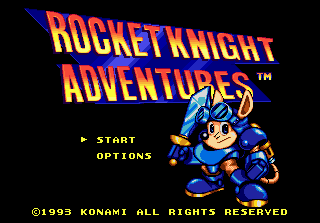
Rocket Knight Adventures is a platform game developed and published by Konami for the Sega Genesis. The game involves Sparkster, a possum knight who wields a rocket pack and sword that can emit energy projectiles as he attempts to stop the Devotindos Empire, an evil empire that attempts to break the seal of a powerful starship.
Rocket Knight Adventures was designed by Nobuya Nakazato, designer of Contra games such as The Alien Wars, Hard Corps and Shattered Soldier. It was released in Japan and North America in August 1993 and in Europe in September. Upon release, the game received positive reviews.
Rocket Knight Adventures is a side-scrolling platform game where the player guides Sparkster through linear levels. The player can jump and attack using Sparkster's sword, which can either hit enemies directly or by emitting energy projectiles that travel a short distance. If the Attack button is held until the blue bar on the top of the screen is filled in, Sparkster will charge a 'rocket attack'. When the player lets go of the Attack button, Sparkster will perform a rocket attack where he bursts into one of eight directions where the player has inputted on the directional pad or otherwise, a stationary spin attack if no directions are pressed. The rocket attack can be used to rebound off walls, allowing Sparkster to reach higher areas.
Sparkster has a limited amount of vitality that decreases when he is hit by enemies, projectiles or stage hazards. The player will lose one life if either the vitality bar depletes, Sparkster falls into a bottomless pit or outside the stage or touches instant-killing terrain such as spikes in the cart segment of the second stage and the lava at the beginning of the third stage. Sparkster can replenish vitality by collecting apples and bananas, the latter replenishing the most vitality. The amount of vitality replenished depends on the game's difficulty level. The game ends if the player runs out of extra lives, however the player is allowed to use a limited number of continues (except in the Very Hard (Crazy Hard in Japan), where there are no continues) and can start at the beginning of the stage where they got a Game Over. Extra lives can be obtained by collecting 1UP items spread throughout some levels; or by achieving 20,000 points, with each other extra life being obtained every 60,000 points.
The game is composed of seven stages, with each stage composed of several sections and each one ending with a boss fight. Levels are occasionally switched up with alternate styles of gameplay. Some sections of the game are played similar to horizontal scrolling shooters (akin to Gradius, often with in-level references to that game), while the boss fight of the fifth stage has the player controlling a large robot mech to duel with the antagonist Axel Gear.
The game features four difficulty options, with harder difficulties increasing the power of the enemy attacks and reducing the number of lives and continues the player starts with; the hardest starting with no lives and continues, and enemy attacks defeating Sparkster in one hit. The difficulty levels in the game are differently presented in each regional version of the game. Both the Japanese and European versions have two difficulty levels accessible normally via the options menu; while all four difficulties are enabled by default in the American version.