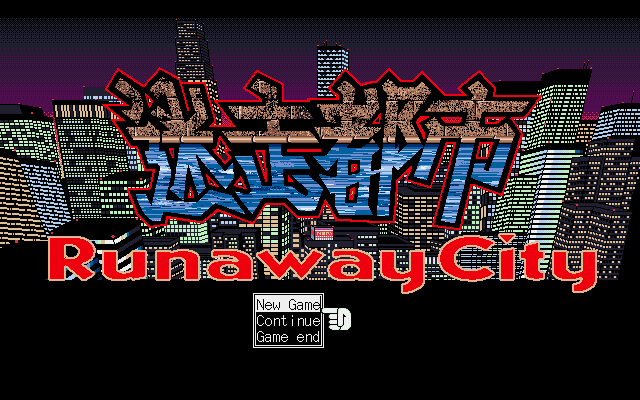
Runaway City is an adult-themed visual novel developed for MS-DOS and released in 1995. The game is known for its mature narrative, interactive elements, and status as one of the early entries in the hentai gaming genre. Designed to cater to a niche audience, Runaway City combines storytelling with adult content, characteristic of visual novels of the era.
In Runaway City, players assume the role of Hiroaki Hanya, a college student dealing with the aftermath of his mother's suicide. Living with his father, the head of a major video game publishing corporation, Hiroaki is uncertain about his future. However, he discovers that he possesses an unusual kind of luck, particularly in his interactions with women. As women are inexplicably drawn to him, Hiroaki finds himself navigating a series of intimate and surreal encounters. The core of the story revolves around uncovering the mysterious source of this 'magic' luck.
The game utilizes traditional Japanese adventure mechanics, allowing players to interact with the world through menu-based commands such as 'Look,' 'Talk,' 'Think,' and 'Go.' The narrative progresses based on the choices made by the player, with multiple paths and outcomes available. A significant portion of the game is dedicated to explicit sexual scenes, during which players are given detailed options to direct the events.
Runaway City features anime-style artwork typical of early 1990s visual novels. The character designs and background illustrations reflect the aesthetic of the era, with expressive characters and atmospheric settings. Despite its limited graphical fidelity due to the hardware constraints of the time, the game effectively conveys its intended themes. Some scenes include voice acting, adding a level of immersion uncommon for games of its time.
The game was released primarily in Japan and catered to a specific demographic interested in adult-oriented visual novels. It gained notoriety outside Japan for its explicit content and became a cult classic among enthusiasts of the genre. Reviews of Runaway City are mixed, with critics noting its engaging narrative but critiquing its straightforward gameplay mechanics. The inclusion of branching paths and interactive choices was praised for adding replay value.
Runaway City occupies a notable place in the history of visual novels as an example of early attempts to merge storytelling with mature content. Its focus on character-driven narrative and player interaction set a precedent for more polished visual novels in subsequent years. While its gameplay is simplistic by modern standards, the game remains a reference point for fans and collectors interested in the evolution of the genre. Today, Runaway City is considered abandonware and is accessible through online archives, ensuring its preservation for future generations.
The game is no longer commercially available but can be played through emulation or abandonware websites. Physical copies, including the original box art, are rare and sought after by collectors.