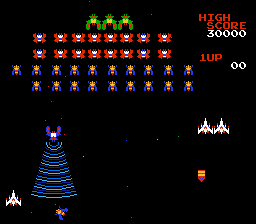
Galaga is a fixed shooter created by Namco for Japanese arcades in 1981 and distributed in North America by Midway. It followed the 1979 game Galaxian and transformed its basic formation-shooting design into a faster and more varied contest for high scores. Namco released this conversion for the Japanese Famicom in 1985, and Bandai later brought it to international NES markets, using the subtitle Demons of Death in North America. The player controls a starfighter confined to horizontal movement along the bottom of the screen and must survive increasingly aggressive waves of insect-like aliens.
Each stage begins with enemies entering the screen in carefully choreographed groups before settling into a formation near the top. They then break away in diving attacks, fire at the player's position and attempt to collide with the fighter. New attack patterns are introduced as the stage count rises, and enemies become more dangerous while entering the formation. Clearing every alien advances the game, while losing the final reserve fighter ends the attempt and records the player's shooting accuracy.
Galaga's most distinctive idea is the tractor beam used by the larger Boss Galaga. If the player's fighter is captured, it is carried into the enemy formation and may later return as a hostile escort. Destroying the Boss while it is diving can rescue the captive ship and join it to the current fighter, producing a Dual Fighter with twice the firepower. The reward is substantial, but the combined craft is also twice as wide and therefore much easier to hit, turning a deliberate loss into a memorable risk-and-reward decision.
After every few normal stages, a Challenging Stage replaces direct combat with a procession of enemy groups following fixed flight paths. They do not shoot or ram the player, so the aim is purely to destroy as many as possible before they leave the screen. Each hit earns bonus points, while eliminating the complete wave awards a large perfect bonus. These interludes test timing and knowledge of the patterns, provide relief from the normal danger and give skilled players an important opportunity to increase their score.
Beneath its simple controls, the game rewards restraint and observation. Firing constantly can leave both permitted shots travelling harmlessly near the top of the screen, while waiting for a diving enemy to approach creates a better chance of scoring and surviving. Different aliens are worth more points when destroyed in flight than when sitting in formation, and the hit-ratio display encourages accurate shooting. A second player can join in an alternating contest, making the score table and survival time the principal measures of success.
The NES version is among the closest early home adaptations of Galaga. The vertical arcade display had to be rearranged for a horizontal television picture and the sound is simpler, yet the enemy formations, capture sequence, Dual Fighter and Challenging Stages behave much like their arcade counterparts. Clear graphics and precise control make it particularly suitable for high-score play, while the alternating two-player option preserves the competitive character of the machine. Its later inclusion on Nintendo's Virtual Console services and the NES Classic Edition helped keep this conversion widely available.