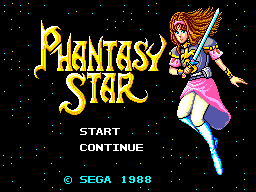
Phantasy Star is Sega’s first original console role-playing game and the opening chapter of a series that became one of the company’s enduring creations. It was released in Japan for the Mark III/Master System on December 20, 1987, followed by North American and European releases in 1988. Its combination of science fiction and fantasy, a female lead and smoothly animated first-person dungeons gave the Master System a distinctive large-scale adventure. Rather than relying only on a medieval setting, it places swords, magic, spacecraft and robots within the same world, making exploration feel like a journey across an entire civilization.
The setting is Algol, a solar system containing the green planet Palma, desert-covered Motavia and icy Dezoris. King Lassic’s oppressive rule provides the starting point for the story: after his forces kill Nero, Nero’s sister Alis sets out to oppose him. Her personal loss leads into a wider struggle for the people of Algol. Three companions join her: Myau, a talking feline creature; Odin, a powerful warrior; and Noah, a magician known as Lutz in the Japanese version. Their different abilities turn Alis’s solitary departure into a party adventure spanning all three planets.
Travel across the overworld uses a top-down view, linking towns, wilderness and dungeon entrances. Conversations supply clues, shops sell equipment, and healing facilities help the party recover before another expedition. Advancement involves finding important objects and improving the party’s weapons, armor and abilities rather than simply following a marked path. Space travel and vehicles gradually broaden the accessible world. Encounters with the Governor of Motavia, the eccentric scientist Dr. Luveno and the petrifying monster Medusa give that progression memorable landmarks. The cartridge’s battery-backed saving allows the lengthy journey to be continued across multiple sessions.
Entering a dungeon changes the perspective to a first-person view of corridors, junctions and stairways. The smoothly scrolling passages are among the original game’s most striking technical achievements, giving its mazes a convincing sense of depth on 8-bit hardware. They also demand attention: similar-looking corridors make orientation difficult, and drawing a map can be as useful as carrying better equipment. Random encounters interrupt exploration both underground and outside. The contrast between colorful planetary landscapes and enclosed labyrinths gives the journey a rhythm of discovery, preparation and cautious descent into unknown territory.
Combat is turn-based, with commands for physical attacks, magic, items, escape and attempts to talk to an opponent. Conversation can help with certain enemies, although it is no universal substitute for fighting. Animated enemy illustrations give encounters a lively presentation, while the party’s growing strength and expanding spell selection provide a clear sense of development. Experience and money reward victories, but repeated battles can wear down health and magic reserves before an expedition reaches its goal. Success therefore depends on judging when to press forward and when to return to safety, not just on selecting the strongest attack.
Phantasy Star helped establish a distinctive place for Sega in the emerging console RPG tradition and laid the foundations for successors such as Phantasy Star II. Its later appearances in collections for Saturn, Game Boy Advance and PlayStation 2, and on Wii’s Virtual Console, reflect its lasting place in the company’s history. Alis was a notable early female lead in a console RPG, while the science-fiction setting and first-person dungeons showed how broad the genre’s possibilities could be. Preserved today, the game is a vivid record of the moment when an 8-bit cartridge could promise more than a brief challenge: a sustained journey through a coherent world, carried by characters, discovery and the player’s own memory.