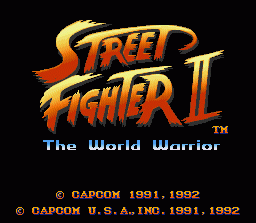
Street Fighter II: The World Warrior is a one-on-one fighting game developed by Capcom and released for the Super Nintendo Entertainment System in 1992. Based on the company's 1991 arcade hit, it is the sequel to the original Street Fighter and was the first home-console conversion to capture most of the qualities that had made its successor a worldwide phenomenon.
The player chooses from eight fighters representing different countries and combat styles: Ryu, Ken, Chun-Li, Guile, Blanka, E. Honda, Zangief and Dhalsim. Each combines ordinary punches, kicks, throws and defensive moves with distinctive special techniques entered through directional and button commands. Winning the single-player tournament requires defeating the other seven competitors and then the four unplayable bosses Balrog, Vega, Sagat and M. Bison.
Matches are fought over timed rounds, with the first character to win two rounds taking the contest. Three strengths each of punches and kicks give the combat unusual variety, while differences in reach, speed, power and special attacks make every fighter behave differently. Accidental animation cancelling in the arcade design also made combinations of successive attacks possible, helping to establish the combo as a fundamental feature of later fighting games.
The SNES controller's four face buttons and two shoulder buttons reproduce the original six-button arrangement particularly well. The conversion retains all eight playable fighters, their stages and endings, a two-player versus mode and bonus challenges, including the famous car-smashing sequence reminiscent of Final Fight. Some animation, background detail and arcade content were reduced, but the colourful graphics, responsive controls and recognisable music remain remarkably close to the source for an early 16-bit cartridge.
Street Fighter II became one of the defining releases for the SNES and helped move competitive fighting games from arcades into living rooms. Later editions added playable bosses, greater speed and further balance changes, yet The World Warrior preserves the straightforward form in which many console players first encountered the series. Its roster is smaller and its rules less elaborate than those of its successors, but the clear character design and carefully constructed combat still explain its enormous historical influence.