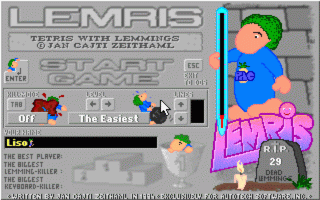
Lemris is a puzzle video game developed by Czech programmer Jan Zeithaml and published by Autotech Software in 1994. Released for MS-DOS and later distributed as freeware, the game combines the falling-block mechanics of Tetris with creatures inspired by the popular puzzle game Lemmings. It is a single-player title presented in a 320 × 200 resolution and was designed as a humorous variation on two of the best-known puzzle games of the period.
The basic gameplay closely follows the traditional Tetris formula. Groups of four blocks fall from the top of the screen and can be moved or rotated before reaching the existing structure. Completing a horizontal line removes it and awards points, but it also causes a small lemming-like creature to appear on the playing field. These creatures walk continuously across the blocks, turn around when they encounter obstacles and can easily be crushed by newly placed pieces. Their presence gradually makes the board less predictable and forces the player to consider more than simply completing rows.
Before beginning a game, the player can select a starting difficulty, choose the number of partially completed rows already present on the board and decide whether killing the creatures is permitted. In the easier “death” variant, crushing them provides bonus points and has few negative consequences. The alternative “alive” mode requires the player to protect them, with points being deducted whenever one is killed. This turns an otherwise familiar falling-block game into a more demanding puzzle, as the player must create safe spaces for the wandering creatures while still preventing the blocks from reaching the top of the screen.
The presentation is simple but contains several playful details. The interface displays the score, completed lines, current difficulty, the next piece and statistics for the different block shapes. A gravestone records the number of killed creatures, while another indicator shows how many are currently walking around the board. The game also includes digitized voice samples and visual effects associated with their deaths, reinforcing its deliberately dark sense of humour. High-score tables record not only the final score but also completed lines, difficulty, killed creatures and even the number of key presses.
Although Lemris lacks the balance and refinement of the games that inspired it, its unusual central idea gives it a distinct identity among the many Tetris variants released for DOS. The mode based on killing the creatures adds little strategic depth, since they can usually be ignored or eliminated without much difficulty. Protecting them is considerably more interesting, as it changes the placement of every block into a decision involving both line completion and the safety of the moving characters. The result is a modest but inventive freeware puzzle game whose strange combination of familiar concepts remains amusing and surprisingly challenging.