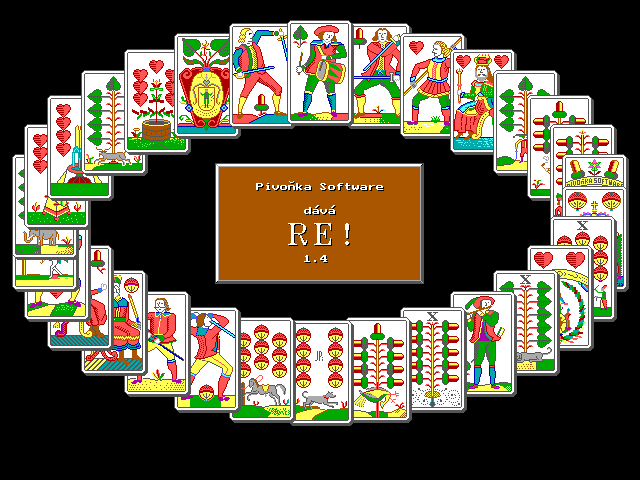
Re! is a computer game simulation of Auction Mariage, developed in 1993 for MS-DOS by Czech programmer Ing. Jaroslav Pivoňka. It was his second game based on the traditional Central European card game Mariage, following the earlier and successful Flek! (1991), which simulated the Called Mariage variant. Both games were officially distributed on 3.5“ floppy disks, with the latest versions of both sold together for 500 CZK. Re! is a single-player game in which the computer simulates the two remaining players.
The game is keyboard-controlled, with arrow keys used for card selection, Enter for confirmation, and Esc for quitting. The interface is simple but functional, reflecting the design limitations typical of early 1990s DOS games. The primary focus is on faithfully simulating the rules and gameplay flow of Auction Mariage, a three-player trick-taking game using a 32-card German-suited deck (Acorns, Leaves, Hearts, Bells).
Gameplay follows the standard format: each player is initially dealt 5 cards, followed by two face-down cards (the talon) and then another 5 cards per player. The player to the dealer's left becomes the forehand and holds bidding priority. Players take turns offering contracts (known as announcements) of increasing value. The forehand responds with 'I hold' ('mám') if they believe they can fulfill the contract. Bidding continues until no higher offer is made. The winner of the auction takes the talon, discards two cards, and announces a contract of equal or higher value, playing solo against the other two players.
Following the auction, players may use doubling declarations (flek, re, sup, tuti) to raise the stakes. The game includes a wide range of contracts, including Seven, Better Seven, Hundred, Hundred and Seven, Betl (no tricks), and Durch (all tricks), along with higher-level announcements that combine these with point targets. Notably, the forehand always leads the first trick, unless the contract is Betl or Durch. This rule mirrors the traditional structure of Mariage variants played in Czech-speaking regions.
If no player bids even a Seven, the deal is voided. A player who wins the auction with a Seven but declines to play must pay a penalty ('mistake') equal to the value of a doubled game. Higher contracts such as Better Seven must be played once declared. All players are free to declare flek and subsequent raises on any contract as they see fit. Re! offers a technically accurate and detailed simulation of Auction Mariage, and it remains one of the few digital implementations of this complex and culturally significant card game available for MS-DOS.