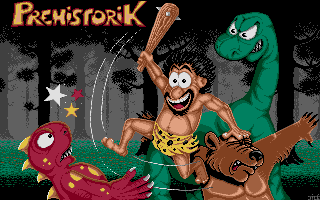
Prehistorik is a platform video game developed and published by the French company Titus in 1991. It appeared for MS-DOS, Amiga, Atari ST, and Amstrad CPC, with a version also available for Commodore CDTV. The player controls a club-wielding caveman searching for food in a fictional prehistoric world. The setting combines dinosaurs, other animals, and exaggerated cartoon characters rather than attempting a historically accurate portrayal of prehistoric life.
The main objective is to gather enough food while making it safely through hostile environments. Defeated animals provide food, and additional supplies can be found in caves. Collecting food is a condition for progressing rather than merely an optional way of increasing the score. Each ordinary level also has a time limit, so the player must balance exploration with a steady advance toward the exit. The combination of combat, jumping, and searching for provisions gives the game a more specific structure than a simple race to the end of a level.
The club is the basic means of attack, and some creatures require several blows before they are defeated. Other hazards cannot be eliminated and must be avoided, including opponents that throw objects from positions beyond the caveman's reach. Close-range combat makes the timing of each approach important: attacking too late can bring the character into contact with an enemy. Collectible bonuses include improved weapons, bombs, extra lives, additional time, and enhanced jumping ability, allowing the player to temporarily improve the character's chances of survival.
The game contains seven levels, alternating four exploration stages with three boss encounters in the even-numbered levels. Its environments include tropical vegetation, snowy landscapes, caves, and volcanic terrain. The exploration stages combine platforms, dangerous creatures, and cave entrances containing supplies or bonuses. Boss encounters concentrate on overcoming a large opponent, providing a change of pace from collecting food and negotiating the landscape. Despite its relatively small number of levels, the game therefore alternates between two distinct forms of challenge.
The visual presentation emphasizes caricature, with an oversized protagonist, expressive creatures, and a deliberately humorous treatment of hunting and survival. Contemporary reception included an 85% rating for the Amiga version in the August 1991 issue of Amiga Action. The review praised the graphics, sound, and gameplay, while suggesting that the puzzle elements could have been developed further. This assessment applies specifically to the Amiga release; it should not be treated as a separate evaluation of the DOS version, whose audiovisual presentation reflects a different hardware platform.
A sequel, Prehistorik 2, followed in 1993 for DOS and Amstrad CPC, expanding the same caveman premise. The related Prehistorik Man subsequently brought the series to Nintendo systems, and it is this title that later appeared on Nintendo DSi. The original game's historical importance lies chiefly in establishing the series' recognizable protagonist and its combination of cartoon comedy, close-range combat, and food collection. It represents the early-1990s tradition of European computer platform games in which a distinctive visual theme and straightforward action formed the basis for a continuing series.