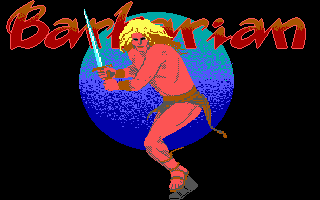
Barbarian is a fantasy action-adventure game originally developed and published by Psygnosis for the Amiga and Atari ST in 1987. It was subsequently converted to several other computers, with the MS-DOS edition appearing in 1989 through Melbourne House and Mastertronic. The DOS conversion was programmed by Randall Don Masteller, while the original concept was credited to Garvan Corbett and Psygnosis co-founder David H. Lawson. The game is unrelated to Palace Software’s similarly titled fighting game Barbarian: The Ultimate Warrior.
The player controls Hegor, a muscular warrior seeking revenge against the evil sorcerer Necron. His journey begins outside Necron’s domain and continues through a largely continuous succession of swamps, caverns, bridges and underground chambers populated by hostile creatures and deadly traps. Hegor must eventually defeat Necron and dispose of the source of his power. The adventure has no conventional selection of levels, and progress depends on surviving the entire journey with a limited supply of lives.
Hegor can walk, run, climb, jump in either direction, collect objects and fight with several weapons. He begins with a sword, while a bow, limited supplies of arrows and a shield can be found during the adventure. Most enemies can kill Hegor with a single successful attack, making careful timing essential. Some opponents require particular weapons or tactics, while environmental hazards must be crossed with precisely executed jumps.
The game’s most distinctive feature is its icon-based control system. Available actions are displayed along the bottom of the screen and can be selected with a mouse, joystick or keyboard-controlled pointer; the DOS version also assigns actions directly to the function keys. The system was designed to provide numerous commands despite the single-button joysticks common at the time, but selecting the correct icon during fast action can be cumbersome. Combined with the absence of a save function and only three lives, this makes Barbarian considerably more demanding than its basic platforming and combat might suggest.
The DOS edition uses colourful MCGA graphics with large character sprites and detailed animation, although its mostly black backgrounds are less elaborate than the scenery of the Amiga and Atari ST versions. It has no continuous musical accompaniment, but delivers effects and even distorted digitized speech through the PC speaker. The fantasy presentation is reinforced by Roger Dean’s striking cover artwork, adapted from his Red Dragon painting. Contemporary reviewers praised the original game’s ambitious graphics and atmosphere, while criticism focused on its awkward controls, repetition and frequent unavoidable deaths. Despite these flaws, Barbarian is an interesting early Psygnosis production whose cinematic presentation and unusually extensive command system anticipated the company’s later emphasis on visually distinctive games.