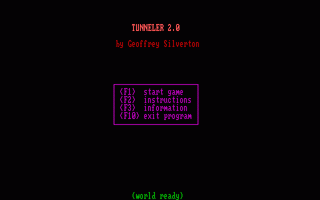
Tunneler is an early two-player, split-screen tank game in which both players begin underground at random locations and compete to destroy each other. Because the playfield initially consists entirely of solid terrain, players must tunnel through the earth to navigate the environment. Locating the opponent is a central element of gameplay, as each player uncovers the map by carving out their own network of passages. Encountering an opponent’s tunnels provides a potential route toward their base, but branching paths, dead ends, and deliberate misdirection can hinder pursuit.
Although the game employs a shared split-screen display, allowing both players to see one another’s actions at all times, this does not eliminate uncertainty. Players remain unaware of the opponent’s exact position until their tunnels intersect, and the moment such a connection is made, both sides gain information simultaneously. This dynamic creates a blend of exploration, strategy, and anticipation, as each player must balance offensive movement with attention to energy consumption and defensive positioning.
Reception of Tunneler has consistently emphasized its strong multiplayer experience. Players have described the game as offering unusually intense competitive action, with the proximity of the two bases and the possibility of accidental early encounters contributing to its tension. The game has been noted for its short learning curve and strategic depth, making it accessible while maintaining replay value.
Criticism of the game has been minimal. Reviewers commonly state that its minimalist graphics do not detract from the experience and that enhanced visuals would not significantly improve gameplay. Instead, Tunneler is frequently cited as an example of effective design through simplicity, prioritizing clear mechanics and direct interaction over presentation.
Retrospectively, Tunneler is often regarded as a demonstration of the potential of early two-player computer games. Its combination of straightforward controls, strategic tunneling, and open visibility through split-screen play has contributed to its lasting reputation. Observers frequently summarize the title as a work of “simple elegance,” reflecting its focus on core gameplay rather than audiovisual complexity.