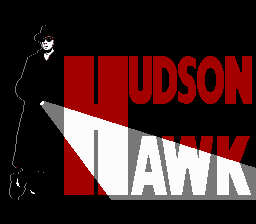
Hudson Hawk was a licensed platform game developed by Special FX Software and published by Ocean Software in 1991 for the Amiga, Amstrad CPC, Atari ST, Commodore 64, Nintendo Entertainment System, and ZX Spectrum, with a Game Boy version following in 1992. In North America, the NES and Game Boy releases were handled by Sony Imagesoft, while in Spain the game appeared under the title El Gran Halcón.
Based on the 1991 comedy-action film of the same name, the game followed Eddie “Hudson Hawk” Hawkins, a master cat burglar who was released from prison intending to retire, only to be forced back into crime. The story revolved around a machine created by Leonardo da Vinci that could transform lead into gold, powered by a crystal split into three parts and hidden inside three of his creations. Wealthy villains Darwin and Minerva Mayflower sought the missing pieces, kidnapped Hawk’s partner Tommy “Five-Tone” Messina, and compelled Eddie to steal the remaining artifacts for them.
The plot sent Hawk through a series of locations tied directly to that premise, including Rutherford’s Auction House in New York, the Vatican, and Castle Da Vinci in Italy. Rather than using a loose movie tie-in setup, the game followed the film’s heist structure quite closely, framing each stage as part of Hawk’s attempt to recover the crystal fragments, rescue Tommy, and stop the Mayflowers’ plan to destabilize the world economy with unlimited gold.
Gameplay combined side-view platforming with light stealth and object-based puzzle elements. Hawk could defeat enemies with a punch or by throwing an infinite supply of baseballs, which also served practical purposes such as distracting guard dogs and activating switches. He could crawl to avoid bullets and security beams, shimmy across ropes and pipes to bypass traps, and push or stack boxes to reach higher ledges or hidden routes. These mechanics gave the game a more deliberate pace than a straightforward action platformer.
The stages featured a deliberately eccentric mix of enemies and hazards that reflected the offbeat tone of the film. Alongside ordinary security guards and guard dogs, Hawk also had to contend with janitors, crazed nuns, balloon-riding henchmen, paparazzi, and even children on bicycles. This unusual enemy roster, combined with the heist-themed settings and the use of baseballs as Hawk’s main tool, helped make Hudson Hawk a distinctive licensed platform game of the early 1990s.