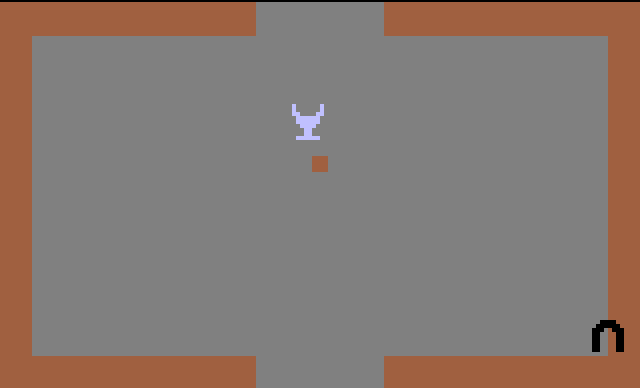
Adventure is a pioneering action-adventure game designed and programmed by Warren Robinett for the Atari 2600 and published by Atari. Completed in 1979, it reached the market in 1980. Inspired by the 1977 version of the text game Colossal Cave Adventure, Robinett spent roughly a year translating exploration and object-based puzzles into a graphical world controlled with a joystick. He worked within a cartridge capacity of 4 KB and just 128 bytes of console RAM. The player appears as a small square, but the kingdom extends across thirty rooms containing castles, pathways and mazes, with creatures and objects that remain active beyond the current screen.
According to the manual, an evil magician has stolen the Enchanted Chalice, which must be recovered and returned to the Golden Castle. Three colored keys open the matching golden, black and white castle gates. Other useful objects include a sword for fighting dragons, a magic bridge for crossing walls within a room, and a magnet for retrieving objects, including ones stuck beyond reach. The bridge cannot open a locked castle or carry the player across a screen boundary. Objects are picked up by touching them and dropped with the joystick button, and the player normally carries only one at a time. Some awkward passages and interactions are described in the manual as 'bad magic'. Finding keys and choosing which object to carry are central to progress, a useful point of comparison with the later exploration game Montezuma’s Revenge.
Three dragons obstruct the quest. Yorgle, the yellow dragon, fears the gold key, roams the kingdom and may guard the chalice or help the other dragons. Grundle, the green dragon, guards the magnet, bridge and black key, while Rhindle, the red dragon, guards the white key and is the fastest and hardest to evade. A dragon pauses with its jaws open before swallowing the player, leaving a brief opportunity to escape. The left difficulty switch shortens this hesitation in position A. The sword kills through contact with the dragon; the right difficulty switch in position A makes dragons flee from it. After being swallowed, pressing Game Reset returns the player to the Golden Castle and revives slain dragons, while objects remain where they were. Game Select instead returns to the selection screen and abandons the current quest.
A black bat adds unpredictability in the two larger game variants by carrying an object and periodically exchanging it for another, even outside the room currently on screen. It can move living or dead dragons as well as ordinary items, suddenly taking away a needed key or bringing danger into a previously safe location. Its behavior alternates between seeking a new object and temporarily keeping its existing load, preventing endless immediate exchanges. The player can catch and carry the bat together with its cargo or attempt to confine it in a castle. It continues flying after the player has been swallowed and can even carry the dragon containing the player around the kingdom. Robinett intended the name Knubberrub for the creature, although it did not appear in the manual.
Game Select offers three variants, all beginning at the Golden Castle. Game 1 uses a smaller kingdom with fixed starting positions and omits the red dragon, bat, catacombs, white castle and black castle maze. Game 2 includes the complete kingdom, with all objects and creatures starting in predetermined locations. Game 3 retains this larger map but randomizes the starting locations of objects and dragons, making knowledge of the map useful without allowing the same route to solve every quest. Beyond the normal goal lies a hidden room displaying 'Created by Warren Robinett'. The signature was concealed because Atari did not publicly credit its game designers, and discovering it requires finding and using a hidden object.
Adventure is widely recognized as a foundational action-adventure game, combining real-time movement, combat, exploration and the use of objects in a connected graphical world. Its return-after-defeat system and independently moving creatures demonstrate ideas that would become familiar features of later adventures. The hidden author credit became one of gaming’s best-known early Easter eggs, while sales of more than a million copies showed the appeal of this approach on a home console. Despite its simple shapes and sparse presentation, Adventure established an influential model of a game world to investigate rather than a single screen to master, and has since appeared in numerous Atari collections.