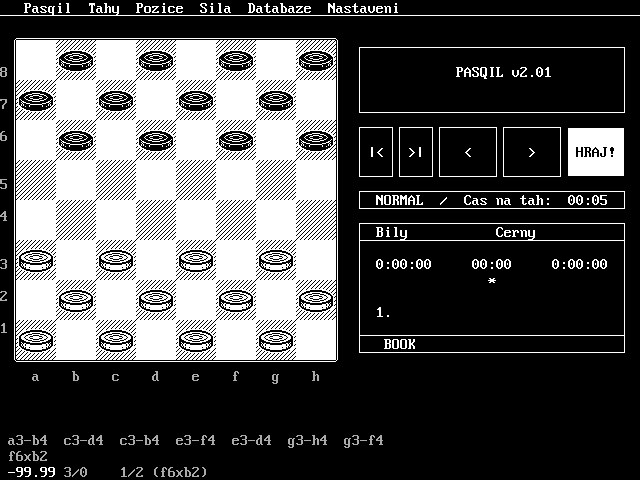
Pasqil is a Czech draughts program created by Miloš Zavřel for MS-DOS and distributed as freeware. The original version appears to have been released in 1998, while the surviving version 2.01 dates from 2000 and includes game databases updated during the following years. Written entirely in assembly language without external programming libraries, the program requires a 386-compatible computer, DOS 5.0, 640 KB of memory, a mouse and access to a disk for storing games and configuration data.
The program implements Czech draughts, played with twelve pieces on each side of an eight-by-eight board. Ordinary pieces move and capture diagonally forward, while kings can travel and capture over longer distances in either direction. Capturing is compulsory, and a king must be used when both a king and an ordinary piece can capture. Pasqil also includes “losing draughts”, a variant in which the objective is to dispose of one’s own pieces rather than capture those belonging to the opponent. A game may be played against the computer, between two human participants or with Pasqil controlling both sides. Several calculation limits are available, including 5, 10, 15 or 30 seconds per move and complete-game time controls ranging from 5 to 30 minutes. A special strength setting can be adjusted manually, while analytical functions display the program’s evaluation, principal variation and the opponent’s possible threat. Moves can be taken back or replayed, the board can be rotated and the computer’s calculation can be interrupted with the right mouse button.
Pasqil is considerably more than a simple board-game opponent. It contains a position editor, an editable opening book holding as many as 6,500 positions and a database system based on the Portable Draughts Notation format. Up to one hundred database files can be selected, with as many as 2,000 games displayed in the list at one time. Games can be sorted or filtered by players, result, date, opening, length and playing strength. The supplied archive includes both computer matches involving earlier versions of Pasqil and recorded games from the 2001 Czech championship.
The presentation is functional rather than decorative, although the player can select three-dimensional pieces and adjust several display options. The accompanying documentation openly identifies two departures from official Czech rules: the program does not recognize a draw by threefold repetition, and in unusually long capturing sequences a king may cross a square on which a captured piece previously stood. These limitations prevent version 2.01 from being a perfect tournament referee, but its analysis tools, opening-book editor and extensive database support make it an unusually ambitious domestic draughts program. Pasqil is therefore valuable not only as a playable opponent, but also as a surviving example of specialized Czech freeware created for serious board-game enthusiasts.