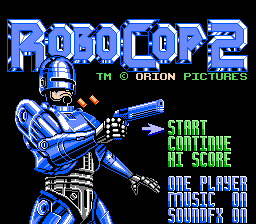
RoboCop 2 is a side-scrolling action platform game based on the 1990 film of the same name. It follows RoboCop and places the cyborg police officer Alex Murphy in a campaign against the drug Nuke and its distributor Cain in Detroit. The first home-computer adaptations appeared in 1990; the NES version, developed by Painting by Numbers, followed in 1991, with Ocean publishing it in Europe and Data East in North America.
The NES game combines shooting with platform challenges and police objectives. RoboCop must destroy at least 60 percent of the Nuke and arrest at least 60 percent of the designated suspects in each applicable stage. Nuke is destroyed by contact, and suspects must likewise be touched rather than shot; their portraits appear at the top of the screen to identify them. Simply reaching the exit is therefore insufficient, since missed drugs or arrests can prevent further progress.
If the required quotas have not been met, a shooting range offers an alternative way to advance. The player must hit enough targets within a time limit and with limited ammunition. Success allows the next stage to begin, while failure requires the previous stage to be repeated. Only two such opportunities are available during an entire game, and using the continue option does not restore them. Once both have been spent, failing a quota means replaying the stage directly.
RoboCop's movement has noticeable inertia, making precise jumps and stopping on slippery surfaces important. Batteries replenish energy, while weapon pickups provide limited supplies of special ammunition. Hidden bonus areas offer additional Nuke or puzzle challenges. The adventure leads through industrial sites to Cain and finally a confrontation with the heavily armed RoboCop 2 prototype. A two-player option is available, but players take turns rather than controlling two characters simultaneously.
Other versions of RoboCop 2 use different levels and interpretations of the same film. The Commodore 64 game also uses collection and arrest quotas, while the Spectrum, GX4000, Amiga and Atari ST adaptations place their own emphasis on platforming, exploration and supplementary challenges. Data East's separate 1991 arcade game instead supports simultaneous two-player action and includes sequences viewed from behind RoboCop. The NES version's defining feature is its combination of combat with measurable police duties, giving it a different structure from that arcade release and from the later RoboCop 3.