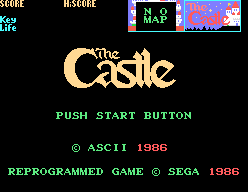
The Castle is a puzzle-platform game developed by ASCII Corporation and converted by Sega for the SG-1000 in 1986. The original computer game had appeared in Japan in 1985, with versions for systems including the FM-7, PC-8801, PC-9801 and Sharp X1, followed by further conversions. Sega's SG-1000 edition was the only contemporary console version of the first game and was released exclusively in Japan. The player controls a young prince who enters a vast castle to rescue an imprisoned princess.
The castle consists of 100 interconnected rooms arranged as a ten-by-ten grid. Each chamber occupies a single screen and may contain several exits, although reaching them often requires more than simply walking or jumping across the room. A map found near the beginning records the chambers already visited and shows the princess's location, but it does not reveal how the individual puzzles must be solved. Exploration is therefore non-linear, with keys and useful objects discovered in one part of the castle opening routes elsewhere.
Most puzzles involve manipulating the environment. The prince can push blocks and other movable objects into position to construct steps, cross gaps, operate lifts or gain access to high platforms. Doors are colour-coded and require matching keys, each of which disappears after being used, so opening them in an unwise order can complicate later progress. Conveyors, moving platforms and other mechanisms must also be understood, while a badly positioned object can leave a room temporarily impossible to complete. The room can be restored to its original state through a special command, but doing so costs one life.
The prince has no conventional weapon and must avoid the castle's inhabitants and hazards, which include knights, wizards, animated flowers, roaming flames, spikes and crushing machinery. Contact with an enemy or a dangerous obstacle usually costs a life, making careful observation and precise movement as important as solving the underlying puzzle. The fixed-screen presentation is colourful and easy to read, although the character's small jumps and the need to position objects accurately can make some rooms demanding.
The Castle is considerably larger and more intricate than its simple appearance suggests. Its combination of platform action, persistent exploration, item-based progression and interconnected rooms anticipates ideas later associated with exploration-focused platform games. The absence of detailed instructions within the game and the possibility of wasting keys make progress difficult without mapping and experimentation, but the carefully linked puzzles give the adventure a strong sense of discovery. ASCII subsequently expanded the concept in Castle Excellent, released internationally for the NES as Castlequest.