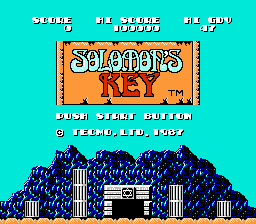
Solomon's Key is a puzzle game developed by Tecmo in 1986 for arcade release on custom hardware based on the Z80 chipset. It is better known as a 1987 port to the Commodore 64 and the Nintendo Entertainment System, although it also appeared on many other game systems of the time, like the Sega Master System in 1988 and the Famicom Disk System, released in Japan on January 25, 1991.
The game is generally recognized as one of the most difficult games to appear on the NES. The player, controlling a sorcerer known only as Dana must overcome unlimited enemy spawning, challenging level designs, a countdown timer, instant death from any physical contact with enemies, and limited ways to dispatch enemies. In addition, it is easy for players to unintentionally render levels unwinnable while playing them. There is no saving, so if all lives are lost at level 49, the game has to be restarted from the beginning. However, a cheat code allows the player able to continue at the level where the last life was lost, except when used past level 41, in which case the player will restart at level 41. Solomon's Key has many hidden items and secret levels that are hard to find which enhances the reward for playing. The ending slightly changes depending on which secret levels, if any, the player finds and completes.
In 1993, a prequel was released for the NES named Fire 'N Ice in North America (called Solomon's Key 2 elsewhere).
The main character, named Dana, is sent to retrieve 'Solomon's Key' to restore the world to light from demons that were accidentally released. The object of the game is to advance through the 50 rooms of 'Constellation Space' by acquiring a key to the door that leads to the next room before a timer runs out. The game incorporates elements of the platform shooter genre. Dana can run, jump, create or destroy orange blocks adjacent to him as well as create fireballs to destroy demons. The orange blocks can also be destroyed by hitting them with the character's head twice. Along the way Dana can acquire items to upgrade his firepower and extra lives as well as items that award bonus points and unlock hidden rooms. With certain items, Dana must make, then break blocks (sometimes in a certain manner) to make these appear.
In the NES version, a 'GDV' (Game Deviation Value) score also appears at the game-over screen. The score uses a weighted composite of several factors (like levels completed, items found, time and points) which gives the player a good idea of how well the last game was played. The higher the GDV, the better the game.