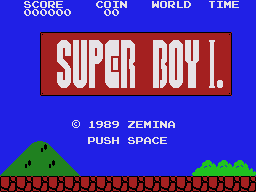
Super Boy is an unlicensed platform video game developed by the South Korean company Zemina and originally released in 1989 for the MSX computer system. The game was later ported to the Sega Master System and various Famiclone systems, particularly in South Korea and other parts of Asia. Super Boy is notable for its blatant similarities to Nintendo’s Super Mario Bros., borrowing heavily from its gameplay mechanics, visuals, and level design, despite having no official license or association with Nintendo.
The gameplay of Super Boy closely mirrors that of Super Mario Bros.. Players control a character known as Super Boy, who navigates side-scrolling levels filled with enemies, obstacles, and power-ups. The objective is to reach the end of each level while avoiding hazards and defeating enemies by jumping on them or using projectiles. The game includes traditional platforming elements such as breaking blocks, collecting items (like coins), and power-ups that grant abilities similar to Mario’s, such as increased size and fireball attacks. However, Super Boy introduces some differences, including unique level designs and enemy placements that deviate slightly from its source of inspiration.
Graphically, Super Boy is a crude imitation of Super Mario Bros.. While it attempts to recreate the familiar aesthetic, the visuals are generally of lower quality, featuring simplified sprites and less polished animations. Backgrounds and character models often appear rough, and color palettes are limited compared to contemporary official games. The audio design is similarly basic, with music and sound effects that lack the sophistication and charm of Nintendo’s work. These limitations are characteristic of many unlicensed games produced during this era.
Reception of Super Boy has been mixed, largely due to its unlicensed status and derivative nature. While some retro gaming enthusiasts appreciate the game for its novelty and as a piece of video game history, others criticize it for being a blatant copy with inferior gameplay and production values. The controls are often described as stiff or unresponsive compared to the smooth mechanics of Super Mario Bros., and the overall difficulty balance can be inconsistent, with some levels being disproportionately challenging or poorly designed.
Despite its shortcomings, Super Boy is a notable example of the unlicensed video game scene in South Korea during the late 1980s and early 1990s. It highlights the early efforts of companies like Zemina to produce homegrown gaming content, even if it involved cloning popular foreign titles. Today, Super Boy is primarily of interest to collectors and retro gaming historians exploring the unlicensed and bootleg gaming markets of the past.