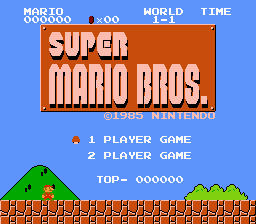
Super Mario Bros. is a side-scrolling platform video game developed and published by Nintendo, first released for the Famicom in Japan on September 13, 1985. The player controls Mario, a plumber who traverses the Mushroom Kingdom to rescue its kidnapped princess. Designed by Shigeru Miyamoto and Takashi Tezuka, it expanded the brothers' adventures beyond the single-screen action of the earlier Mario Bros. from 1983. The game reached North America during the NES launch period and Europe and Australia in 1987. It established the Super Mario series by combining an immediately understandable goal with a world that stretched far beyond the screen, combining platform traversal with exploration and hidden rewards.
Mario travels through the Mushroom Kingdom to rescue Princess Toadstool, now generally known as Princess Peach, from Bowser, a huge, fire-breathing turtle king whose horns and spiked shell give him a dragon-like appearance. In the two-player mode, players take turns as Mario and his brother Luigi; both brothers have the same abilities in this original game. The journey to the princess spans eight worlds with four stages each, for a total of 32 levels. Outdoor courses, underground passages and underwater sections give way to a castle at the end of each world. The first seven castles end with a decoy Bowser and a rescued mushroom retainer, one of the kingdom's small, mushroom-headed inhabitants, who explains that the princess is being held elsewhere. The princess herself appears only after the eighth world's final confrontation.
The gameplay centres on running, jumping and overcoming obstacles. The directional pad steers Mario, A makes him jump, and holding the B button increases his running speed. Jump height depends on how long the A button is held, while a running start helps cover wider gaps. The screen follows progress from left to right and does not scroll back, making missed opportunities part of the challenge. Jumping on a Goomba, a small walking mushroom-like enemy, destroys it, whereas a Koopa Troopa, a turtle soldier, retreats into its shell. Kicking that shell can destroy several enemies at once, but the shell can rebound from a wall and endanger Mario himself. Enemies standing on blocks can also be struck from below.
Collectible power-ups modify Mario’s abilities while retaining the basic control scheme. A Super Mushroom, a growth-granting mushroom, enlarges Mario, allows him to break ordinary bricks and lets him survive a hit that his smaller form would not survive. A Fire Flower, a magical flower, grants fireballs, and a Starman, a bouncing star, provides temporary protection against enemies, although it cannot prevent death in a pit. Question-mark blocks reveal coins or items, while other rewards hide in ordinary or invisible blocks. Hidden items and alternative routes add an exploratory element to the linear progression through stages.
Lives, coins and the countdown keep exploration under pressure. Collecting 100 coins earns an extra life, as do certain mushrooms; chains of defeated enemies can also yield additional lives. Mario loses a life when hit while small, falling into a pit or running out of time. Most non-castle stages end at a flagpole, while castles require overcoming Bowser to reach a captive mushroom retainer or, in the final castle, the princess. Pipes lead to bonus rooms, hidden beanstalks open routes above the ground, and hidden Warp Zones allow players to skip ahead to later worlds. Knowledge of stage layouts, item locations and secret shortcuts supports both exploration and faster completion.
The opening stage, World 1-1, is a notable example of introducing game mechanics through level design. Its first enemy, blocks, mushroom and pipes introduce the rules through play rather than lengthy instructions. Nintendo's developers described repeatedly revising layouts originally drawn on graph paper, with the opening stage receiving adjustments late in development. Koji Kondo's music gives the adventure another unifying rhythm: the bright overworld theme, underground accompaniment, underwater music and castle theme lend different settings distinct identities. The integration of visual design, music and progressively demanding obstacles gives the game a consistent identity.
The original's success led to two different games bearing the name Super Mario Bros. 2. Japan received the 1986 Famicom Disk System sequel later known internationally as Super Mario Bros.: The Lost Levels, which retained the basic formula but added much harder stages, poison mushrooms and wind. The Western Super Mario Bros. 2 arrived in North America in 1988 and Europe in 1989. Adapted from Doki Doki Panic, it introduced a dream-world adventure with four selectable heroes: Mario, Luigi, the princess and Toad, a mushroom-headed companion. Lifting and throwing enemies and objects replaced the original's emphasis on defeating enemies by jumping on them. These contrasting sequels showed that Mario could support both tougher variations and substantial changes of direction.
Super Mario Bros. sold more than 40 million copies in its original NES/Famicom release and became a defining title for Nintendo's console. Its many later reissues and the expanded ideas of games such as Super Mario Bros. 3 testify to a design whose influence extends far beyond its original hardware. Its historical achievement was to unite responsive movement, readable stages, secrets and musical character into a coherent adventure. Preserved as a work of game history, it remains a clear example of how a few simple actions can support a rich world, and why the side-scrolling platform game became one of the central forms of console play.