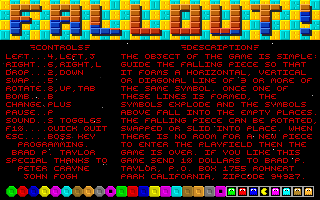
Fallout is a single-player falling-block puzzle game created by Brad P. Taylor and released for MS-DOS in 1991. It was distributed as shareware and follows the colour-matching principle associated with Columns. It is unrelated to the later post-apocalyptic role-playing series of the same name.
The player arranges falling groups of three coloured tiles inside a rectangular playing field. A horizontal, vertical or diagonal line of at least three matching tiles disappears and awards points. Tiles above the cleared spaces then fall into the gaps, changing the arrangement of the remaining blocks and potentially forming further matches.
The game uses keyboard controls. Besides moving a falling group sideways and dropping it, the player can change the order of its three tiles and rotate the entire group between vertical and horizontal positions. These two separate operations provide different ways of fitting the same combination into the existing pile. Occasionally a falling group includes a bomb, which can destroy nearby tiles.
The settings distinguish between level and difficulty: the former determines the speed of play, while the latter changes the number of colours or patterns used. More tile types make matching combinations harder to assemble. The appearance of the tiles can also be changed during play with the plus key, allowing the same puzzle to be displayed with different sets of symbols.
Fallout includes sound, a high-score table, a pause function and a boss key for quickly hiding the game. Its central challenge combines recognising colour patterns with choosing the order, orientation and placement of each falling group. The ability to rotate whole groups, together with the occasional bombs, gives this variation on the Columns formula its own set of tactical possibilities.