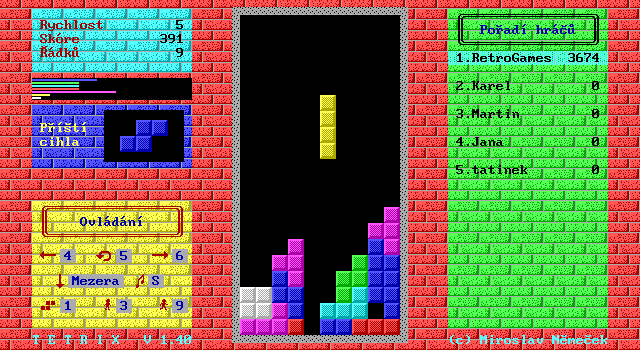
Tetrix is a Czech Tetris-inspired puzzle game written by programmer Miroslav Němeček for MS-DOS. Version 1.30 was distributed by the software company Golem in 1992 and was also associated with its DOS Manager package. Němeček later released an updated version 1.40 through GEMA Soft in 1996 as freeware. Like his better-known game Vlak, Tetrix is a compact program written in assembly language and designed to run on comparatively modest IBM PC-compatible computers.
The basic rules closely follow Alexey Pajitnov’s original Tetris. Pieces formed from four square blocks descend into a ten-column playfield and can be moved sideways or rotated before they settle. Completing a horizontal row removes it and lowers everything positioned above, while the game ends when the accumulated blocks reach the top of the playing area. The current score, selected speed and number of completed rows are displayed beside the playfield.
Tetrix allows the player to begin at any of ten speed settings, numbered from zero to nine. Unlike most contemporary versions of Tetris, the speed can also be increased or decreased during play. Choosing a slower setting makes the pieces easier to control but substantially reduces the number of available points, while playing at higher speeds is rewarded more generously. The preview of the next piece can similarly be switched on or off during a game, with its use carrying a scoring penalty.
The program includes a table of named players in which individual high scores can be retained. It also offers an automated demonstration mode capable of placing and rotating pieces without human assistance. Keyboard controls support both the cursor keys and the numeric keypad, while sound effects produced through the PC speaker can be disabled. The graphical presentation is uncomplicated but colourful and supports EGA, VGA and Hercules display hardware.
Tetrix adds no new piece types or alternative game modes, but its adjustable speed, optional preview and persistent player table make it more flexible than many minimal Tetris clones. Its small size, immediate accessibility and modest hardware requirements made it well suited to the way Czech DOS games were copied and exchanged during the early 1990s. Although overshadowed by Němeček’s Vlak, Tetrix remains an interesting example of early Czech PC game development and a technically accomplished domestic interpretation of one of the world’s most influential puzzle games.