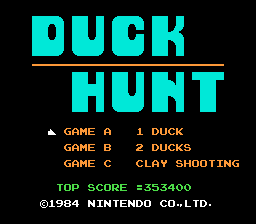
Duck Hunt is a light-gun shooting game developed and published by Nintendo for the Famicom and Nintendo Entertainment System. It debuted in Japan in April 1984 and joined the North American NES launch lineup in October 1985, followed by a European release in 1987. Its basic challenge is to shoot moving targets before they escape, using a limited supply of shots. Nintendo had previously used the Duck Hunt name for a 1976 electronic shooting toy, which projected ducks rather than running a video game on a television.
On the original console, Duck Hunt is played with the NES Zapper, a light gun aimed directly at the television screen. This setup was designed for CRT televisions and does not work normally with modern LCD displays. The game presents the shooting field from the hunter’s viewpoint, without a visible player character. Like the related Zapper title Hogan’s Alley, it makes aiming at the screen the main form of interaction. There is no need to navigate a level: success depends on following a moving target and choosing when to pull the trigger.
Game A sends out one duck at a time, while Game B sends out two together. Each round contains ten ducks, and the player has three shots for each appearance: in Game B, those three shots must cover both birds. A time limit prevents waiting indefinitely for an easy shot. A hunting dog flushes the ducks from the bushes, holds up successful catches and laughs when the player misses. Game A also supports an unusual two-player arrangement, with one person using the Zapper and the other steering the duck horizontally and vertically with a standard NES controller.
Game C replaces the woodland hunt with clay-target shooting. Two clay pigeons fly away into the distance, becoming smaller and harder to hit, while the player again has three shots for each pair. In all three modes, a minimum number of successful hits is needed to advance; failing to meet the quota ends the game. Later rounds increase the challenge through faster targets and stricter requirements. Hits earn points, and clearing all ten targets in a round awards a perfect-round bonus. The highest score is retained during the current session but disappears when the console is switched off.
The rounds are numbered from 1 to 99. In Game A, advancing beyond Round 99 produces Round 0, an erroneous stage commonly described as a kill screen, where duck behavior breaks down rather than providing a normal continuation. Duck Hunt also reached a much wider audience through bundled cartridges: it shared one with Super Mario Bros., and a later three-game cartridge added World Class Track Meet. In 2014, Nintendo reissued the game on Wii U Virtual Console, adapting the aiming controls to the Wii Remote instead of requiring an original Zapper and CRT television.
Duck Hunt occupies a distinctive place in NES history as an early showcase for light-gun play and a game many owners encountered alongside their console. Its three shooting modes turn a simple aiming mechanic into challenges of reflexes, accuracy and limited ammunition, while the laughing dog gives failure a memorable personality. The combination of accessible rules, a dedicated peripheral and widespread inclusion in NES bundles helped make Duck Hunt one of the system’s most recognizable shooting games. It remains a clear example of how an unconventional controller could define the experience of a home video game.