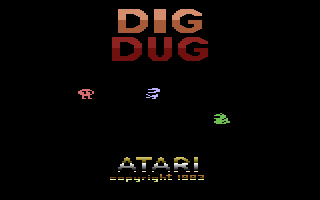
Dig Dug is an action game created by Namco and first released in Japanese arcades in 1982, with Atari distributing it outside Japan. The Atari 2600 conversion followed in October 1983 and was developed and published by Atari as one of the first home versions of the arcade hit. Despite the severe graphical and memory limitations of the console, it preserves the original objective, both enemy types, falling rocks and the scoring system in recognisable form. Its simple premise conceals a carefully balanced score-driven design in which every tunnel changes both the player’s escape routes and the paths available to the enemies.
The player controls the underground digger Taizo Hori, although early Western material generally identifies him simply as Dig Dug. Each round is cleared by defeating its Pookas and Fygars. Pookas are round, goggle-wearing creatures, while the dragon-like Fygars can breathe fire horizontally. Dig Dug attacks with an air pump: once its hose catches an enemy, repeated pumping inflates the creature until it bursts. A partly inflated monster is temporarily harmless but will recover if the attack is interrupted.
Enemies normally follow the tunnels but can transform into ghostly eyes and pass slowly through solid earth, preventing the player from remaining safe behind untouched soil. Contact with either creature is fatal, as are Fygar’s flames and any rock that Dig Dug accidentally brings down on himself. When only one enemy remains, it attempts to escape through the upper-left corner. The round ends whether the fugitive is destroyed or gets away, but allowing it to flee sacrifices the remaining points.
Rocks provide a more dangerous and rewarding alternative to the pump. By tunnelling beneath one, the player can make it fall and crush several monsters at once, but must leave enough space to escape the collapse. Enemies destroyed deeper underground are worth more, and a Fygar inflated from the side awards double points because this exposes Dig Dug to its horizontal fire. Digging itself also increases the score, turning apparently empty movement into another opportunity for optimisation.
After two rocks have fallen, a temporary food or object bonus appears near the centre of the field. Later rewards include a flagship from Namco’s Galaxian, linking the game with another of the company’s arcade successes. Reaching the bonus before it vanishes often requires abandoning a safe route and crossing tunnels already used by the monsters. Dig Dug therefore rewards not only survival but also deliberate risk-taking and knowledge of how each scoring rule interacts.
Flowers record the round number, the colour of the soil changes periodically and later stages contain more enemies moving at higher speed. Since the basic layout remains familiar, variety comes chiefly from increased pressure and the unpredictable routes created during play. The arcade original eventually reaches an unplayable kill screen on round 256, although individual home conversions do not necessarily reproduce that programming fault. The absence of a conventional ending makes the pursuit of a high score and mastery of increasingly fast rounds the principal long-term goals.
The Atari 2600 cannot reproduce the arcade machine’s detail, animation or colours, and its figures and tunnels are considerably simpler. What matters most, however, survives: the controls are responsive, the two methods of attack create meaningful choices and increasingly aggressive enemies maintain constant pressure. As an adaptation for hardware introduced in 1977, it is an effective and surprisingly complete interpretation of Dig Dug rather than merely a loose imitation.