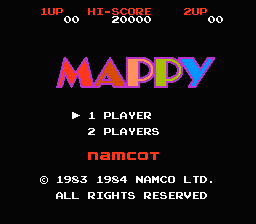
Mappy is a side-scrolling platform game created by Namco for arcades in 1983. Distributed in the United States by Bally/Midway, it turns the familiar rivalry between cats and mice into a cartoon police chase. The hero is Mappy, a mouse policeman whose name is generally thought to come from mappo, a mildly derogatory Japanese slang term for a police officer. The arcade original runs on a modified version of Namco's Super Pac-Man hardware, adapted to support horizontal scrolling. The Famicom version was released in Japan in 1984 and adapts this arcade design to Nintendo's home console.
Mappy enters the mansion of the thieving Meowkies, known as Mewkies in Japan, to recover stolen goods. The arcade controls consist of left and right movement and a button for operating doors; reaching another floor depends on trampolines rather than a conventional jump button. The original mansion has six floors, while some conversions use fewer. Mappy and the cats can leave a trampoline shaft for a hallway on the way up, but not while falling. Ordinary cats cannot hurt Mappy while he is bouncing, although meeting an active cat on a hallway costs a life. Four consecutive bounces break a trampoline, with changes of colour warning of its condition; landing on a floor resets it.
The stolen objects appear in matching pairs, and collecting the second immediately after the first multiplies its value. Successive pairs increase this multiplier from x2 to x6, so planning the route can earn much more than simply grabbing the nearest object. In the arcade scoring system, beginning with the tape players at 100 points each and ending with the safes at 500 points each produces 8,500 points for all five pairs when collected in the best order. The larger boss cat Goro, called Nyamco in Japan, also patrols the mansion. He moves quickly but is less relentless than his smaller companions, and sometimes hides behind the loot. Recovering an object that conceals him adds a 1,000-point bonus to its normal value.
Doors provide Mappy's main defence. They swing toward their knobs, and hitting a cat with an ordinary door briefly stuns it and awards 50 points. The cats can operate ordinary doors too, sometimes stunning themselves, and can walk through open doorways. Special flashing doors, blue in the arcade original, can initially be opened only by Mappy. They release a horizontal microwave that gathers up the cats in its path and sweeps them off the screen. Catching several cats together increases the reward, and including Goro doubles the wave's score. The defeated cats soon return from above, so a wave creates breathing room rather than permanently clearing the mansion.
Each round ends when all the stolen goods have been recovered. Taking too long brings a Hurry warning: the music speeds up, the cats become faster and more aggressive, and additional Meowkies enter the building. Further delay summons Gosenzo, a green disc bearing Goro's face. Unlike the ordinary cats, this pursuer can kill Mappy even in midair and cannot be stopped by the microwave doors. These escalating threats discourage waiting indefinitely for a safe opening. Later arcade stages also introduce features such as bells that can be dropped onto cats to stun them, while the hurry-up warning begins sooner.
In the arcade original, round three and every fourth round thereafter are bonus stages. With no cats chasing him, Mappy bounces through a course of trampolines to pop fifteen red balloons worth 200 points each and a large Goro balloon worth 2,000. Popping them all before the music finishes adds a 5,000-point bonus; breaking a trampoline and falling out of the course ends the attempt. The original arcade game cycles through 256 rounds, with the final one displayed as Round 0 before play returns to the beginning. This numbering belongs to the arcade game and should not be assumed to describe every home version. Like Pac-Man, Mappy rewards practice and high-score chasing, but its distinctive challenge lies in combining route planning, fragile trampolines and carefully timed doors.