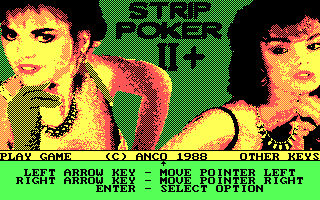
Strip Poker II Plus is a 1988 adult card game developed and published by Anco Software Ltd. for multiple home computer platforms including MS-DOS, Amiga, Atari ST, Commodore 64, BBC Micro, MSX, ZX Spectrum and others. It is part of the strip poker subgenre of videogames that emerged in the 1980s, in which a traditional five-card draw poker simulation is combined with progressively revealing digitized imagery as a reward for winning hands. The title served as one of several unofficial sequels to early strip poker game Strip Poker: A Sizzling Game of Chance, using its own interface and presentation.
Gameplay in Strip Poker II Plus revolves around standard five-card draw poker mechanics. The player begins with a set amount of money (commonly $100) and participates in rounds of betting, drawing and comparing card hands against a computer opponent. Bets start at a base amount and may be raised within predefined limits, and strategic choices such as staying, folding or raising influence the outcome of each hand. Opponents in the game—typically depicted as female characters such as “Donna” and “Sam”—lose articles of clothing as the player wins hands or accumulates money. The ultimate objective is to continue winning until the opponent has no clothing left, at which point the game presents progressively more revealing digitized images.
Technically, the game used low-resolution digitized photography to represent opponents and their changing state of dress, a novelty for its time despite the inherent limitations of 8- and 16-bit hardware. While some contemporary coverage noted this use of digitized imagery as a selling point, others described the visuals as being of limited fidelity, reflecting the technological constraints of the era. The title’s interface and controls are straightforward, with simple keyboard or joystick input used to navigate menus and make betting decisions.
Critical reception to Strip Poker II Plus was mixed to negative. Magazines of the period varied widely in their assessments: a review in The Games Machine rated the game around 60%, indicating an average reception, while other publications expressed more critical views, sometimes describing it as little more than a basic poker simulation with added adult imagery. Later retrospective commentary on versions such as the Amiga port has characterized its AI as simplistic and its overall gameplay as shallow, often recommending real poker or more substantive simulations over the game’s strip poker framework.
Despite its niche appeal and limited depth as a gambling simulation, Strip Poker II Plus remains a notable example of the strip poker subgenre that was popular in the late 1980s. It reflects both the era’s experimentation with digitized graphics and the broader trend of combining traditional game mechanics with adult-oriented content in early home computer software. Its multi-platform release and presence on a variety of 8- and 16-bit systems have contributed to its recognition among retro gaming enthusiasts and historians of early adult-themed games.