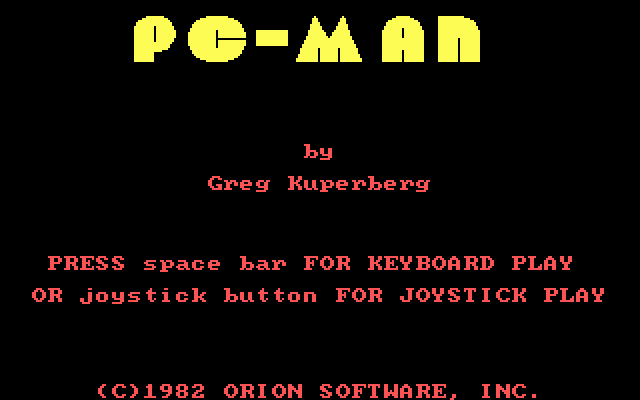
PC-Man is a maze-chase game created by Greg Kuperberg and published by Orion Software in 1982 for the IBM PC. It closely follows Namco's arcade classic Pac-Man, bringing its dot-eating pursuit to an early generation of personal computers. Also known as PC-Man and the Micro Monsters, it was originally released as a self-booting game on floppy disk. Its identity is rooted in the early IBM PC era, when adapting fast arcade action to the new machine was itself a worthwhile challenge.
The objective is straightforward: guide the character through the maze, eat every dot and avoid the four pursuing monsters. Clearing the screen leads to another round, while a collision costs a life. Power pills temporarily reverse the balance, allowing the hunted character to turn on his pursuers and earn extra points. These familiar rules create the game's rhythm: choosing a route, escaping a dangerous junction and deciding when to use a power pill matter more than simply moving quickly.
The most conspicuous change from the arcade model is the maze's orientation. PC-Man rotates it by 90 degrees to fit the wider IBM PC display instead of the arcade machine's tall screen. CGA graphics also alter the colours, so the monsters do not retain their original arcade hues. Nevertheless, the walls, dots and moving characters preserve the recognisable structure of the game. The result is a practical adaptation that puts the layout and moment-to-moment pursuit ahead of an exact visual reproduction.
Kuperberg wrote PC-Man while still in high school; his other Orion games included Paratrooper and J-Bird. In a later interview, he explained that his games were written in assembly language and drew directly into display memory, avoiding the slow system graphics routines. He also paced their animation at a fixed rate rather than relying on processor-intensive delay loops. These choices help explain the attention to movement and timing in a game whose modest appearance conceals a carefully considered approach to the hardware.
PC-Man's historical importance lies in showing how arcade ideas found an early home on the IBM PC. Its originality rests chiefly in adapting an established design to different display proportions and limited graphics, rather than inventing a new genre. The rotated maze and economical presentation make those compromises visible without obscuring the appeal of the underlying chase. Preserved today, it is both an accessible maze game and a small record of the ingenuity that helped turn the early personal computer into a machine for play.