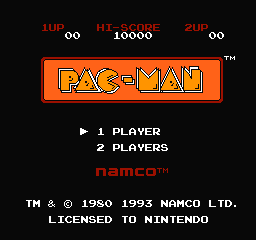
Pac-Man is an arcade game developed by Namco and first released in Japan on May 22, 1980. It was licensed for distribution in the United States by Midway and released in October 1980. Immensely popular from its original release to the present day, Pac-Man is considered one of the classics of the medium, virtually synonymous with video games, and an icon of 1980s popular culture. Upon its release, the game – and subsequent Pac-Man derivatives – became a social phenomenon that sold a large amount of merchandise and also inspired, among other things, an animated television series and a top-ten hit single.
When Pac-Man was released, the most popular arcade video games were space shooters, in particular Space Invaders and Asteroids. The most visible minority were sports games that were mostly derivatives of Pong. Pac-Man succeeded by creating a new genre and appealing to both genders. Pac-Man is often credited with being a landmark in video game history, and is among the most famous arcade games of all time. It is also one of the highest-grossing video games of all time, having generated more than $2.5 billion in quarters by the 1990s.
The character has appeared in more than 30 officially licensed game spin-offs, as well as in numerous unauthorized clones and bootlegs. According to the Davie-Brown Index, Pac-Man has the highest brand awareness of any video game character among American consumers, recognized by 94 percent of them. Pac-Man is one of the longest running video game franchises from the golden age of video arcade games. It is part of the collection of the Smithsonian Institution in Washington, D.C. and of New York's Museum of Modern Art.
The player controls Pac-Man through a blue maze, eating pac-dots (also called pellets) and fruit. When all pac-dots are eaten, Pac-Man is taken to the next stage. Between some stages one of three intermission animations plays. Four enemies (Blinky, Pinky, Inky and Clyde) roam the maze, trying to catch Pac-Man. If an enemy touches Pac-Man, a life is lost and the Pac-Man itself withers and dies. When all lives have been lost, the game ends. Pac-Man is awarded a single bonus life at 10,000 points by default—DIP switches inside the machine can change the required points or disable the bonus life altogether.
Near the corners of the maze are four larger, flashing dots known as power pellets that provide Pac-Man with the temporary ability to eat the enemies. The enemies turn deep blue, reverse direction and usually move more slowly. When an enemy is eaten, its eyes remain and return to the center box where it is regenerated in its normal color. Blue enemies flash white to signal that they are about to become dangerous again and the length of time for which the enemies remain vulnerable varies from one stage to the next, generally becoming shorter as the game progresses. In later stages, the enemies go straight to flashing, bypassing blue, which means that they can only be eaten for a short amount of time, although they still reverse direction when a power pellet is eaten; in even later stages, the ghosts do not become edible (i.e. they do not change color and still make Pac-Man lose a life on contact), but they still reverse direction.