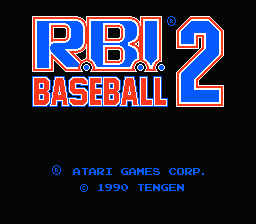
R.B.I. Baseball 2 is a baseball video game and the second instalment in the R.B.I. Baseball series. Developed by Tengen, it originally appeared on the NES in 1990, followed by adaptations for home computers, including MS-DOS, in 1991. The game combines direct control of the action on the field with player selection and team management, using professional baseball statistics as the basis for individual abilities.
The team selection covers all 26 major-league clubs of the period, drawn from the American and National Leagues, together with the 1989 All-Star teams. Rosters feature real players and use statistics from the 1989 season. Recognisable names include Rickey Henderson, pitcher Nolan Ryan and shortstop Ozzie Smith. The expanded selection gives players access to the full league rather than a limited group of clubs.
During a match, the player handles batting, pitching, fielding and baserunning. Success depends both on timing individual actions and on choosing suitable players for particular situations. The statistical model distinguishes abilities such as batting power and running speed, while pitchers differ in their control, throwing speed and stamina. Substitutions therefore have a practical role, allowing the lineup and pitching staff to be adjusted as the game develops.
The available modes include a match against the computer and competitive play for two people. A password system allows progress through a sequence of fixtures to be resumed later. Although described as a season mode, its schedule is a shortened competition with one game against each team in the division rather than a complete major-league season. Watch mode instead assigns both teams to the computer, allowing a match to be viewed without directly controlling either side.
Compared with its predecessor, R.B.I. Baseball 2 retains the central combination of accessible baseball action and real-player data while broadening the choice of teams and lineups. Its structure accommodates a single match, a longer run of fixtures or a computer-controlled demonstration. On the NES, the main interest lies in how the selected roster's strengths interact with the player's decisions on the field, combining the timing of individual plays with the management of the team.