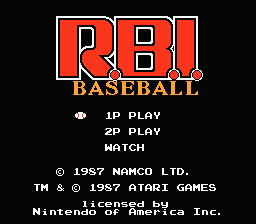
R.B.I. Baseball is a baseball game for the Nintendo Entertainment System, developed by Namco and published in North America by Tengen in 1988. It is based on Pro Yakyuu Family Stadium, which Namco released for the Japanese Famicom in 1986. The initials R.B.I. stand for run batted in, a run credited to a batter for helping a teammate score. The NES game received two sequels, while later entries in the R.B.I. series appeared on systems including the Mega Drive/Genesis, Amiga, Atari ST, Game Gear, Super NES and Sega 32X; these should not be confused with ports of the original game.
R.B.I. Baseball was the first console baseball game licensed by the Major League Baseball Players Association (MLBPA), allowing it to use real player names. It did not have a license from Major League Baseball itself, so official club nicknames and logos were absent. A comparable distinction between player and team licenses appears in Tecmo Bowl. Its eight teams are identified by their locations: Boston, California, Detroit, Houston, Minnesota, New York, St. Louis and San Francisco. They represent the division winners of 1986 (Boston, California, Houston and New York) and 1987 (Detroit, Minnesota, St. Louis and San Francisco). Two additional All-Star teams represent the American and National Leagues, bringing together veterans such as George Brett, Dale Murphy and Andre Dawson, who are absent from the eight regular teams, and emerging stars including Mark McGwire, Andrés Galarraga, Kevin Seitzer and José Canseco.
Batters differ in their ability to make contact, hitting power and running speed, so the choice of player affects both batting and baserunning. Vince Coleman is the fastest runner and particularly difficult to throw out when stealing second base. Pitchers differ in velocity, stamina and how far their pitches can be steered left or right during flight. Fatigue reduces both speed and control. Nolan Ryan and Roger Clemens deliver some of the fastest pitches, Fernando Valenzuela offers substantial movement in both directions rather than an overpowering fastball, and Mike Scott has a sharp breaking ball. The most useful pitcher therefore depends on how these strengths are employed. The game does not clearly establish comparable individual differences in fielding ability.
The eight regular rosters are simplified versions of the corresponding playoff teams, with eight starting batters, four bench players, two starting pitchers and two relievers per team. Any of the four pitchers can start a game, although relievers tire much sooner. In consecutive games played without resetting the system, a starting pitcher used in the previous game must rest and is unavailable for the next one; relievers can appear in successive games. Batting substitutions become available after the game begins, and a pinch hitter can replace a player in any fielding position. Managing the limited bench and pitching staff thus matters beyond the opening lineup.
The batting and pitching statistics displayed when a player steps up to bat or takes the mound are largely based on real results, but they do not always match the abilities used by the game. These figures remain fixed throughout a match or sequence of matches. A separate, simple box score records team totals during and after play, using some unconventional bookkeeping: a batter hit by a pitch is recorded as receiving a walk, while reaching base on a fielding error also adds a hit, even though the opposing team is charged with an error. Conversely, a batter thrown out while trying to stretch a hit into extra bases is not credited with that hit.
The related arcade release, Vs. R.B.I. Baseball, differs from the NES version in its team selection. Its ten teams draw on notable players from ten franchises, with statistics generally representing their best seasons. Mark McGwire is an unusual example: his Oakland entry uses a projected total of 62 home runs rather than a completed career-best season. This figure belongs to the arcade version and should not be mistaken for his NES statistics. McGwire later hit 70 home runs in 1998, setting the major-league single-season record at that time.