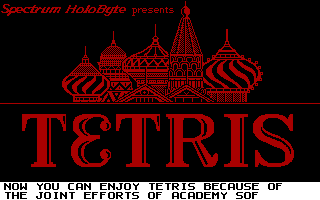
Tetris (Russian: Те́трис, pronounced [ˈtɛtrʲɪs]) is a Russian tile-matching puzzle game, originally designed and programmed by Alexey Pajitnov. Spectrum Holobyte's version was the very first commercial release of Tetris in the United States. It was published in 1988 for the following home computer platforms: Apple II, Apple IIGS, Atari ST, Commodore Amiga, Commodore 64, Macintosh, and MS-DOS. In most cases, these versions were designed from the ground up. Only in the Commodore 64's case was the Mirrorsoft release sold instead.
Along with the version developed by Spectrum Holobyte's European sister company, Mirrorsoft, it was originally released under bogus licensing. However, contracts were later made between Andromeda Software (the sublicensing party), and Elorg, which secured the legality of the products. The Spectrum Holobyte releases are notable for the various Russian themed backgrounds whose display changes with every level.
Tetris is played on a 10 by 20 grid referred to as the Well, or the Matrix. Shapes called Tetriminos fall from the top of the Matrix and come to rest at the bottom. Only one Tetrimino falls at a time. At first the Tetriminos fall rather slowly; as the game progresses, they will fall faster and faster.
All of the Tetriminos which fall and stack on top of one another are referred to as the stack. Although the Matrix is only 20 blocks high, in some versions of the game, Tetriminos are not limited to the top of the Matrix and can go over the uppermost row. The game is over when Tetriminos are forced to overlap at the top of the stack.
There are seven different Tetriminos that can appear throughout the course of the game. These seven pieces represent all of the various ways that you can arrange four contiguous squares. A good understanding of the seven different shapes is required in order to achieve high scores and long periods of play. In general, the seven pieces are referred to by the letters they most closely resemble: I, O, T, S, Z, J and L.
The simplest goal of any Tetris game is to clear a line from the screen. This is accomplished whenever Tetriminos are arranged so that they fill a horizontal row within the Matrix. As the pieces fall, your goal is to move and spin them so that they line up evenly at the bottom of the Matrix. To clear a line, every square of the row has to be filled.
In general, the more lines that you clear simultaneously, the more points you will obtain for the accomplishment. Clearing one line at a time produces the least amount of points. Clearing two or three lines with a single piece earns the player a considerably higher score. The most lines a player can clear with a single piece is four, by placing the I piece vertically. This is known as getting a Tetris.