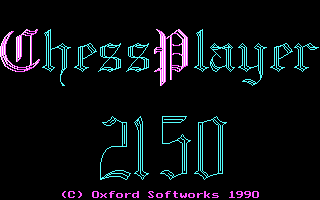
Chess Player 2150 is a computer chess program developed by Chris Whittington and published by the British company Oxford Softworks. It was originally released for the Amiga and Atari ST in 1989, with an MS-DOS conversion following in 1990. The program achieved early recognition by winning the 1989 British Open Personal Computer Chess Championship and also participated in the chess tournament at the first Computer Olympiad held in London that year.
The game allows one player to compete against the computer or two human players to play on the same machine. Its board can be displayed either as a conventional two-dimensional diagram or from a three-dimensional perspective. The DOS version supports both CGA and EGA graphics, although its presentation is simpler than the Amiga and Atari ST editions. Several settings can be adjusted before a game, enabling players to select an appropriate balance between the computer’s playing strength and the time it spends calculating each move.
One of the program’s more unusual features is a rating test consisting of 24 chess positions. The player must find the best continuation in each puzzle, after which the program estimates an Elo rating from the results. This provides a structured challenge beyond ordinary matches, although the resulting figure should be regarded as an approximate assessment rather than an official rating. The program also includes facilities for examining positions and experimenting with alternative move sequences.
The number 2150 in the title advertised the program as a particularly strong opponent for home-computer users. Its engine employed a selective search strategy, concentrating its calculations on moves regarded as most promising rather than examining every possible continuation to the same depth. This could produce deep and effective analysis on the limited hardware of the period, although contemporary reviewers noted that the program could occasionally overlook a tactical possibility and that it was not always especially fast.
Contemporary reception was generally favourable and frequently emphasized the program’s playing strength. In one test it defeated Sargon III in four of six games, while other publications considered it stronger than Chessmaster 2000 and Colossus Chess X and comparable to, or even better than, The Fidelity Chessmaster 2100. Not every reviewer accepted its advertised strength without reservation, but Chess Player 2150 was nevertheless regarded as one of the strongest commercial chess programs of its generation. It was followed in 1990 by the improved Chess Champion 2175, also known in North America as Checkmate.