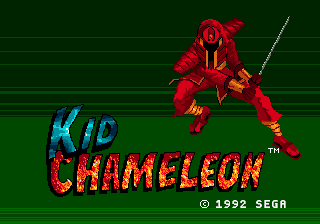
Kid Chameleon is a side-scrolling platform game developed by Sega Technical Institute and published by Sega for the Mega Drive/Genesis in 1992. Known as Chameleon Kid in Japan, it follows Casey, a confident teenager nicknamed Kid Chameleon because of his skill at playing video games. The title was released during the rapid growth of mascot-based platform games, but distinguished itself through an unusually large campaign and a transformation system built around collectible masks.
The story concerns Wild Side, a new virtual-reality game whose artificial intelligence has become self-aware. Its final boss, Heady Metal, begins abducting players and imprisoning them inside the game world. After every previous challenger disappears, Casey enters Wild Side to rescue them and defeat the rogue creature. Although the premise is largely confined to the introduction and ending, its mixture of video games and virtual reality provides a suitable explanation for the constantly changing environments.
Most stages require the player to travel from the starting position to a flag while jumping across platforms, breaking blocks and avoiding enemies, traps and bottomless pits. The game contains more than one hundred stages, although branching routes and hidden teleporters mean that many will not be encountered during a single playthrough. Teleporters can transport Casey to another part of the current stage or send him onto a completely different route through the game, rewarding exploration while making the campaign resemble a large network rather than a simple linear sequence.
Casey’s principal ability comes from masks hidden inside blocks. Each transforms him into a different character with its own health, movement and special skills. Iron Knight can climb walls, Berzerker can smash through barriers, Maniaxe throws axes, Micromax can enter narrow passages, and Skycutter can reverse gravity and walk along ceilings. Other forms provide a sword, greater jumping ability, flight or heavy firepower. Collected diamonds can also activate special powers whose effects depend upon the current transformation. Losing all the form’s health returns Casey to his normal body rather than immediately costing a life, giving the masks both practical and defensive value.
Contemporary reviews were generally favourable, particularly praising the variety created by the transformations, extensive level design and colourful presentation. Sega Force awarded the game 82%, while Console XS gave it 89%; Mega later placed it 35th in its list of the best Mega Drive games. Criticism focused on the increasingly repetitive action and, above all, the absence of passwords or a saving system, which makes completing such a lengthy game unusually demanding. Despite these shortcomings, Kid Chameleon remains one of the more ambitious platform games for the Genesis, combining familiar influences from Super Mario Bros. and Sonic the Hedgehog with a distinctive collection of playable forms and an exceptionally elaborate network of stages.