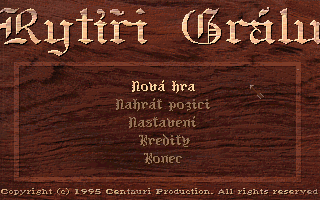
Rytíři Grálu is a Czech role-playing game developed by Centauri Production and published by Vochozka Trading for MS-DOS in 1996. Set in the world of Arthurian legend, it combines first-person exploration with real-time combat. Rather than commanding a party of adventurers, you choose a single knight of the Round Table and guide him on a quest for the Holy Grail. The game belongs to the grid-based dungeon tradition familiar from Dungeon Master and Eye of the Beholder.
The story draws on Arthurian mythology and the film Excalibur. King Arthur is gravely ill, his kingdom is falling into decay, and the sorceress Morgana threatens the land. The Holy Grail offers the hope of healing the king and saving his realm. Your journey begins in Camelot, where exploring the castle and its surroundings introduces the setting before you venture into the forests. Conversations with other characters provide information and help direct the search.
Movement takes place in discrete steps, but the adventure extends well beyond underground corridors. Forests connect settlements, castles and dungeons, including places outside the main quest. An automatic map helps you keep track of the terrain. Underground, switches, pressure plates, keys and concealed passages turn exploration into a series of interconnected puzzles. The contrast between these concentrated challenges and the large, sparsely populated outdoor areas is central to the game's character: its world feels extensive, but travelling through it can also become repetitive.
Combat unfolds in real time, making equipment and the development of your knight important from the outset. Gaining levels allows you to improve his abilities, while the inventory accommodates weapons, armour, food and many other useful objects. Hunger and fatigue add practical demands to the expedition, so supplies and rest matter alongside fighting. Alchemy gives collected herbs a further purpose: recipes and potion-making provide another means of dealing with danger. Progress therefore involves managing the resources of one vulnerable traveller as well as defeating enemies.
Hand-drawn scenery gives the castles, forests and underground chambers their distinctive appearance. Music reinforces the atmosphere, while rain and thunderstorms add variety to the outdoor journey. The game appeared on floppy disks and CD-ROM; the CD edition added Czech voice acting and CD audio music. These presentation details lend personality to a demanding adventure whose broad scope is accompanied by uneven pacing. Its appeal lies particularly in patiently exploring the setting and discovering how its puzzles and systems fit together.
Rytíři Grálu is significant as an early Czech attempt to bring a substantial commercial dungeon RPG to the local market. It applied the established language of first-person role-playing games to an Arthurian adventure presented in Czech, at a time when domestic development was still finding its footing. Its scale and atmosphere remain worth examining alongside its rough edges. As a historical game, it preserves both the ambition and the limitations of that formative period, making it a revealing part of the story of Czech video games.