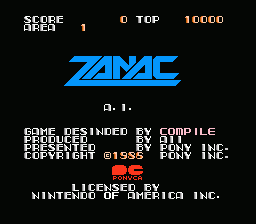
Zanac is a vertically scrolling shoot ’em up video game developed by the Japanese studio Compile. It first appeared for MSX computers in 1986, followed by a substantially revised version for the Famicom Disk System that year and a North American NES release in 1987. Pony Canyon published the game in Japan, while FCI handled the North American release. An enhanced MSX2 version, Zanac EX, provided smoother scrolling and revised graphics. These versions share the same basic concept but differ in their presentation and level design.
The science-fiction story concerns an ancient alien entity called the System, which humanity inadvertently activates and turns into a destructive threat. The player pilots the AFX-6502 Zanac, a solitary spacecraft sent to penetrate its defenses and destroy it. The action is viewed from above, with the landscape scrolling beneath the ship as airborne enemies and ground installations attack. The Famicom Disk System and NES versions contain twelve areas, whereas the original MSX game has eight. Encounters with fortified bases interrupt the advance and require the player to destroy groups of gun emplacements within a time limit.
The ship carries an upgradeable main gun and a separate special weapon. Eight numbered special weapons offer different combinations of attack and protection, including directional fire, penetrating projectiles, and defensive barriers. Collecting a numbered chip changes the equipped weapon, while collecting another chip with the same number strengthens it. This system gives the player a choice between maintaining a familiar weapon and adopting another that better suits the immediate situation. Losing a ship reduces its accumulated firepower, making survival important both for preserving lives and for retaining an effective arsenal.
Zanac’s defining feature is its automatic difficulty control, generally referred to as ALC. Rather than relying solely on fixed enemy formations, the game adjusts the opposition in response to the player’s actions. Frequent firing can intensify enemy attacks, while destroying reconnaissance aircraft or enemy fortresses can reduce the pressure. Consequently, greater firepower does not always make the game easier: aggressive play may provoke a stronger response. The system makes repeated attempts less predictable and places particular emphasis on reacting to changing conditions, alongside learning the layout of each area.
Zanac occupies an important place in Compile’s history as an early expression of the studio’s characteristic combination of fast scrolling, extensive weapon upgrades, and sustained combat. Its legacy continued with the 2001 PlayStation collection Zanac X Zanac, which included versions of the original game alongside the new Zanac Neo. Its principal historical distinction, however, remains its use of adaptive difficulty. At a time when many shooters emphasized memorizing predetermined attack patterns, Zanac also made the player’s behavior part of the challenge, providing a notable early example of a game that actively modifies its resistance during play.