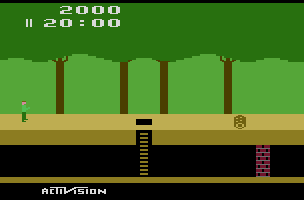
Pitfall! is a platform game designed and programmed by David Crane for the Atari 2600 and published by Activision in 1982. The player guides the explorer Pitfall Harry through a hazardous jungle, collecting treasure within a twenty-minute time limit. Crane, who had already made games for Atari and Activision, built the idea around an animated human figure with a convincing walking motion. The jungle, obstacles and treasure hunt gave that figure a purpose, producing an adventure whose appeal rests on precise movement and the promise of another discovery beyond the edge of the screen.
The world contains 255 jungle scenes and 32 treasures. Like Superman and Adventure, Pitfall! changes screens when the character reaches an edge rather than scrolling continuously. Harry can travel in either direction, and ladders connect the surface to underground passages. Moving through one underground scene covers the distance of three surface scenes, making the tunnels valuable shortcuts. They also contain scorpions and obstructing walls, so choosing a route requires more than simply running forward. Reaching all the treasures in time depends on learning how the two levels of the jungle connect.
Harry begins with three lives and 2,000 points. The treasures comprise money bags worth 2,000 points, silver bars worth 3,000, gold bars worth 4,000 and diamond rings worth 5,000. Collecting everything without losing points produces a maximum score of 114,000. Falling through an open hole or touching a rolling log reduces the score, whereas sinking into a swamp, quicksand or tar pit, or touching a snake, scorpion or crocodile’s open jaws costs a life. The game ends when the time expires, all lives are lost or all treasures have been collected. This distinction between losing points and losing a life makes a clean run a different challenge from merely surviving.
The joystick moves Harry left and right, climbs ladders and controls his grip on swinging vines, while the button makes him jump. Logs and snakes demand accurately timed leaps; vines offer a way across dangerous pits, and crocodiles can be crossed by landing on their heads while their jaws are closed. Some pits open and close, so watching the pattern before committing to a jump is often safer than rushing. The controls are simple, but the succession of hazards gives them considerable variety. Each lost life or point also consumes part of a run that cannot be extended beyond its twenty-minute clock.
Pitfall! became one of the best-selling Atari 2600 games and received praise for its animation and playability. It was adapted for other contemporary systems and followed by Pitfall II: Lost Caverns, which expanded Harry’s adventures into a larger cavern environment. The original has also returned in Activision compilations and as a playable bonus in later games. That continued presence reflects the durability of its central idea: a treasure hunt in which recognizing hazards, mastering jumps and planning a route all contribute to the result, rather than relying on a single repeating screen.
Pitfall! holds a central place in the early history of platform games. It did not yet use the continuous scrolling associated with many later examples, but its connected landscape, surface and underground routes, animated hero and varied traversal challenges helped establish the appeal of a sustained platform adventure. Its strongest achievement is the balance between immediate, readable action and a world large enough to reward exploration and practice. The jungle may be drawn with a few simple shapes, yet the decisions it creates remain clear and engaging: when to jump, where to go and how much risk to take before time runs out.