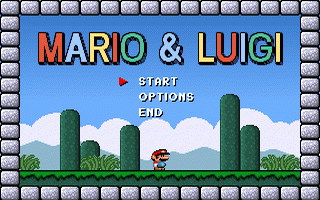
Mario & Luigi is an unofficial platform game created for MS-DOS by Dutch programmer Mike Wiering in 1994. Although closely modelled on Nintendo's Super Mario Bros. series, it is not a direct conversion of any existing Mario title and uses original level layouts created specifically for the PC. Wiering programmed the game in Turbo Pascal as an experiment in VGA graphics and smooth parallax scrolling, aiming to make the engine run well on his 25 MHz 486 computer. He originally intended to reuse the technology in later, more original games rather than release the Mario project commercially.
The game follows the familiar structure of a side-scrolling Mario adventure. Players run and jump through the Mushroom Kingdom, collect coins and defeat enemies by landing on them or attacking them with fireballs. Mushrooms transform Mario into his larger form, while fire flowers grant a projectile attack that can be aimed horizontally or diagonally. Holding the run button allows longer jumps, an important technique for crossing some of the wider gaps. A two-player option is also included, with Mario and Luigi taking turns rather than appearing on screen simultaneously.
The completed game contains six increasingly difficult levels featuring outdoor landscapes, underground passages, water hazards, moving platforms, pipes and castle-like environments. Unlike Nintendo's original games, it has no story sequences, background music or boss battles, and neither Bowser nor Princess Peach appears. The final stage ends with the words “THE END” formed from golden coins. Completing the game starts another, faster cycle in which movement and enemy behaviour become more demanding.
An unusual part of the game's history concerns an unfinished four-level beta version that circulated without Wiering's approval. An unknown party modified it into a supposed shareware release, added documentation and a registration form requesting payment, and distributed it on disks and shareware CD-ROMs. Because its fourth level had never been completed, that version could not be finished and caused many players to search for a nonexistent exit. Wiering later released the authentic six-level edition for free, together with its complete Turbo Pascal source code and optional joystick support.
While technically and visually modest, Mario & Luigi demonstrates accomplished DOS programming through its colourful VGA graphics, layered scrolling and compact size. Its controls can initially feel less fluid than those of Nintendo's console games, but the original stages provide a short and increasingly challenging platform adventure. The engine also became an important foundation for Wiering's subsequent work, eventually contributing to games such as Charlie the Duck and the more polished Mario-inspired platformer Super Angelo.