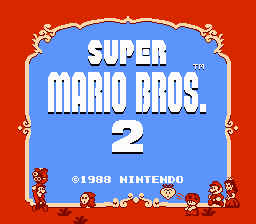
Super Mario Bros. 2 is a platform video game developed and published by Nintendo for the Nintendo Entertainment System, released in North America in 1988 and Europe in 1989. It is the Western sequel to Super Mario Bros. and differs substantially from its predecessor in both setting and gameplay. It should not be confused with the Japanese Super Mario Bros. 2, released in 1986 and later known internationally as Super Mario Bros.: The Lost Levels.
The game's unusual history explains these differences. Nintendo of America considered the Japanese sequel too difficult and too similar to the original for its market. Instead, Nintendo adapted Yume Kōjō: Doki Doki Panic, a game released for the Famicom Disk System in 1987 in connection with Fuji Television's Yume Kōjō event. Its four protagonists were replaced with Mario characters, while much of its level design and object-throwing gameplay was retained. The adaptation also added a running action and removed the requirement to complete the game with all four characters. In 1992, this version was released in Japan as Super Mario USA.
The story takes place in Subcon, a dream world ruled by the frog-like tyrant Wart, whose defeat is the player's main objective. Before each level, the player chooses Mario, his brother Luigi, the mushroom-headed Toad, or Princess Toadstool, now generally known as Princess Peach. Each has distinct abilities: Mario offers a balanced combination of movement and strength, Luigi jumps highest, Toad runs and picks up objects quickly but has a relatively low jump, and the princess can float briefly in the air. All four can climb ladders and vines. Character selection therefore affects how the player negotiates obstacles rather than merely changing the appearance of the protagonist.
The game contains twenty levels divided among seven worlds, with settings ranging from deserts with quicksand to icy areas with slippery surfaces. Horizontal and vertical scrolling, interconnected rooms, doors, ladders, and accessible jars give the levels a different structure from those of the first game. Most enemies cannot be defeated simply by jumping on them: the character can instead stand on them, lift them, and throw them at other opponents. Vegetables pulled from the ground and movable blocks provide additional projectiles. This emphasis on positioning and handling objects extends to boss encounters, while the absence of a time limit allows the player to examine the surroundings and search for hidden routes.
Health is represented by a meter, so a single hit does not necessarily cost a life. Floating hearts replenish it, while mushrooms found in the temporary mirror world called Sub-space increase its maximum capacity. Magic potions create entrances to this area, where the player can also collect coins; entering certain jars there provides shortcuts to later worlds. Cherries eventually produce an invincibility star, and POW blocks eliminate enemies standing on the ground within the screen. Losing all health or falling into a pit costs a life, and after a game over the player can continue twice. Hidden 1-Up mushrooms and the slot machine bonus game between levels, paid for with collected coins, provide additional lives.
Super Mario Bros. 2 broadened the series through its four playable characters, their different abilities, and a combat system built around lifting and throwing. It also brought characters such as the masked Shy Guy and the egg-spitting Birdo into the Mario series, where they continued to appear in later games. Enhanced versions followed in Super Mario All-Stars for the Super NES in 1993 and Super Mario Advance for the Game Boy Advance in 2001. Its historical significance lies in the way an adaptation became an integral part of the series: alongside the more direct Japanese sequel, it established that a Mario game could adopt a different setting and different rules while retaining its identity as a platform game.