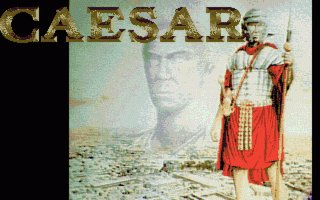
Caesar is a city-building strategy game developed by Impressions Games, first released in 1992 and available on the Amiga and MS-DOS among other platforms. The player takes the role of a Roman provincial governor, responsible for building a prosperous city and defending the surrounding region. Its urban planning resembles SimCity, but the Roman setting introduces military responsibilities and a career based on promotion to more demanding assignments.
The city develops through the placement of housing, roads, water supplies and public buildings. Schools, theaters, libraries and bathhouses provide services whose availability depends on their location relative to residential districts. Construction therefore involves more than filling empty space: the governor must arrange buildings so that growing neighborhoods have access to suitable amenities. The city view presents these decisions as part of a network of interdependent services.
Administration extends beyond construction. Taxes provide income, while building work, soldiers and the annual tribute to Rome compete for funds. The forum gives access to advisors who report on the province's condition. Promotion depends on four ratings: Peace, Culture, Prosperity and Empire, the last reflecting regional transport and communications. Meeting the required standards earns a new posting, with the eventual possibility of becoming Emperor.
A separate provincial map expands the task beyond the capital. Roads link settlements, while defensive walls, garrisons and troop deployment help protect the region against barbarian attacks. Military spending must be balanced against civilian development. Caesar normally resolves battles without a tactical battlefield, but players who also owned Impressions' Cohort II could use that companion game to fight them in detail. Defense is thus part of provincial management rather than a self-contained action sequence.
Caesar combines city design, finances and regional security in a single governorship. The need to satisfy several ratings distinguishes it from unrestricted construction: a wealthy settlement alone is insufficient if other responsibilities are neglected. The game began a series continued by Caesar II and later installments, which expanded its Roman city-building framework. The original remains a comparatively compact expression of that design, centered on balancing the demands of citizens, soldiers and imperial authority.