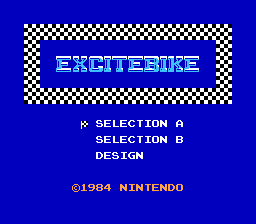
Excitebike is a motocross racing game developed and published by Nintendo, first released for the Japanese Famicom in 1984. It became one of the North American NES launch titles in 1985. Viewed from the side, the races take place on dirt tracks filled with ramps, rough ground and obstacles, with the red-clad rider moving between lanes as the course scrolls past. Beneath this straightforward presentation lies a game of momentum and timing: the fastest route depends as much on controlled jumps and landings as on using the accelerator.
The player can initially choose from five tracks and race in either Selection A, alone, or Selection B, with computer-controlled riders. These riders add moving obstacles, but qualification is determined by the finishing time rather than simply by overtaking everyone on screen. A third-place time or better in the preliminary challenge earns entry to the championship race. The third-place target appears at the lower left, while the leading time is shown on the stadium wall; the initial first-place benchmark is eight seconds faster than the third-place requirement. Improving the best time produces the message 'It’s a new record!', encouraging repeated attempts at the same course.
The A button provides normal acceleration, while B engages a faster turbo that steadily heats the engine. The temperature gauge at the bottom of the screen makes this trade-off visible: prolonged turbo use can overheat the motorcycle and force the rider to stop while it cools. Arrow-marked strips on the track reduce the temperature, so choosing a line through them helps sustain speed. Up and down move the motorcycle between racing lanes, allowing the player to avoid rough patches, approach ramps and maneuver around other riders. Maintaining speed therefore involves managing both the route and the engine.
Left and right adjust the motorcycle’s pitch: left raises the front wheel and right lowers it. In the air, this lets the player prepare for the slope of the landing, while on the ground a wheelie can help negotiate obstacles. A badly judged landing, a collision with a ramp or hitting another rider from behind can throw the player off the motorcycle. Conversely, a computer rider striking the player’s rear wheel is the one who falls. After a crash, repeatedly pressing A and B makes the rider run back to the bike faster. These details turn each jump into a small test of control, with mistakes costing valuable seconds.
Design Mode extends the game beyond its supplied tracks. Using nineteen course elements labeled A–S, players can place ramps and other obstacles, set the finish and choose up to nine laps, then ride their creation alone or with computer opponents. Like the level editor in Wrecking Crew, it gives players a role in constructing the challenge. The Japanese Famicom version could save tracks to cassette tape through the Famicom Data Recorder; the original Western NES release retained Save and Load menu entries without usable saving support. The later Wii Virtual Console edition allowed custom tracks to be retained, and the expanded Vs. Excitebike for Famicom Disk System offered disk-based saving.
Excitebike’s lasting significance lies in how much racing depth it achieves with a few clear controls. Turbo management, lane selection and midair balance make speed something to earn through skill, while the track editor invites players to explore the same design principles themselves. The game began a series that later included Excitebike 64, Excitebike: World Rally and the related Excite Truck and Excitebots: Trick Racing. Its original design also returned in 3D Classics: Excitebike for Nintendo 3DS in 2011, initially offered free to mark the Nintendo eShop launch. As an early NES racer with built-in course creation, Excitebike remains a distinctive example of accessible play that rewards practice and creativity.