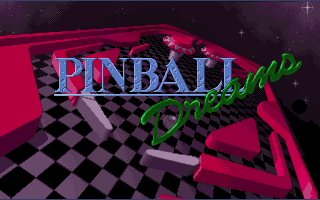
Pinball Dreams is a pinball simulation developed by the Swedish studio Digital Illusions and published by 21st Century Entertainment in 1992. Originally created for the Commodore Amiga, it was the studio’s first commercial game and was subsequently converted to MS-DOS, Super Nintendo, Game Boy, Game Gear and several other platforms. Its success established Digital Illusions as a professional developer and led to sequels including Pinball Fantasies and Pinball Illusions.
The game contains four tables, each with its own theme, layout, rules and soundtrack. Ignition is based on rockets and space exploration, Steel Wheel combines steam trains with the American West, Beat Box follows a band’s progress through the music charts, and Nightmare presents a graveyard filled with ghosts and demonic imagery. The last table is labelled Graveyard on the playing field and is generally the fastest and most difficult of the four.
Rather than displaying an entire table at once, Pinball Dreams follows the ball with a vertically scrolling view. This allows the tables to be considerably taller and more detailed than the screen, although it also means that targets outside the visible area must sometimes be approached from memory. The ball responds convincingly to flippers, bumpers, ramps and changes in speed, while each table is constructed from elements that could theoretically be reproduced in a physical pinball machine.
Scoring depends on learning the individual rules of each table and completing specific combinations of targets, lanes and ramps. Players can tilt the table to influence the ball, but excessive nudging results in a penalty. Several people may compete by taking turns and comparing their scores, while extensive bonus systems and persistent high-score tables encourage repeated play. Music by Olof Gustafsson and the detailed sound effects contribute strongly to the distinct atmosphere of each design.
Pinball Dreams was a major critical and commercial success, selling more than 650,000 copies during its first year. The Amiga original was particularly praised for its smooth scrolling, graphics, music and unusually convincing ball movement, and it became an influential model for later computer pinball games. Some conversions were less successful: Computer Gaming World, for example, criticised the MS-DOS edition’s physics and jerky scrolling. Despite differences between versions, the game remains an important milestone in the genre and the foundation of one of the most highly regarded pinball series of the 1990s.