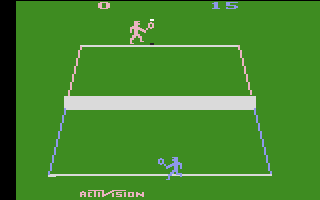
Tennis is a sports video game developed and published by Activision for the Atari 2600 in 1981. It was designed and programmed by Alan Miller, one of the company's co-founders. The game offers singles matches against a computer-controlled opponent or another player. Its presentation consists of a single court with two contrasting player figures, keeping the action focused on movement, returning the ball, and placing shots beyond the opponent's reach.
Four game variations combine one-player or two-player matches with normal-speed or slow-motion play. The joystick moves the tennis player around the court, while the button is used only to serve. During rallies, the character automatically swings the racket when correctly positioned to meet the ball, using a forehand or backhand as appropriate. Shots always clear the net and remain within the court, so the main task is to reach the ball rather than judge the strength of each stroke.
The direction of a return depends on where the ball meets the racket. Contact near its center sends the ball straight ahead, while contact nearer the edge produces a more angled shot. The console's difficulty switches can restrict the sharpest angles separately for each player. This gives the otherwise simple controls a tactical element: the player must position the racket to direct the return while also anticipating the opponent's next shot. Moving toward the net provides opportunities for sharply angled volleys.
Scoring follows the familiar sequence of 15, 30, and 40, including deuce and advantage. A match consists of one set, normally won by taking at least six games with a two-game lead. At 6–6, the displayed game score returns to 0–0 and play continues until one player leads by two games. The slower modes allow more time to react, while normal speed places greater demands on positioning and reflexes. Tennis therefore offers a compact match format with adjustable pace and straightforward controls for either solo or two-player play.