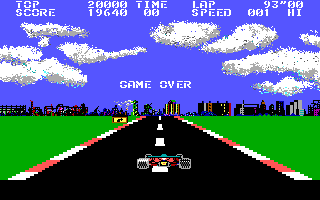
Pole Position II is Namco’s 1983 arcade sequel to Pole Position, expanding its predecessor’s Formula-style racing with a choice of four circuits. Atari licensed the arcade game for manufacture and distribution in the United States. The central appeal remains the view from behind the car: the road stretches toward the horizon, bends approach rapidly and passing traffic demands constant adjustments. Rather than presenting a long championship or a detailed vehicle simulation, the game concentrates on the immediate excitement of a qualifying run followed by a race against the clock.
Before entering the main race, the player must complete a qualifying lap quickly enough to earn a place on the starting grid. A better time means a better starting position and a qualifying bonus. During the race, keeping up speed matters because the clock continues to run through mistakes. Completing a lap within the limit grants more racing time, while distance covered and cars overtaken contribute to the score. The result is an arcade contest in which efficient driving and survival in traffic matter more than simply reaching a finish line ahead of one particular rival.
The original Fuji course returns alongside Test, Seaside and Suzuka. Test offers a relatively simple layout for learning the handling, while the other circuits demand greater familiarity with corners and changes of direction. Choosing a track therefore changes the driving problem rather than merely the background. The arcade Test course resembles Indianapolis, Seaside evokes the Long Beach street circuit and Fuji and Suzuka draw on Japanese racing venues. This expanded selection is the sequel’s clearest advance: a familiar style of play now accommodates several routes that reward practice and memory.
Steering, acceleration, braking and switching between low and high gear form the core of driving. High gear provides speed on open stretches, but approaching a bend or recovering after a crash requires better judgment than holding the accelerator continuously. Collisions interrupt progress and consume precious time. In the original arcade game, revised car colors, explosions with visible debris, new billboards and a new opening tune refresh the presentation without replacing the underlying design. The Japanese timer reads TIME, while the American arcade version uses UNIT; home conversions adapt the audiovisual details to their own hardware.
Mindscape’s DOS conversion brings the four-track format to IBM-compatible computers, supporting CGA or EGA graphics and either keyboard or joystick controls. The keyboard can be redefined, and the manual includes a joystick calibration procedure. The main race allows up to four laps, distinguishing its structure from the Atari 7800 adaptation. These practical changes translate a game conceived for dedicated arcade controls into the more variable equipment of a home computer. The essential task remains recognizable: qualify, build speed, avoid collisions and keep enough time in hand to complete another lap.
Pole Position II preserves an important stage in the development of racing games: the period when a convincing road perspective, responsive steering and a few memorable circuits could turn a brief arcade session into the feeling of a motor race. Its contribution was to broaden an established design through track selection and refinements rather than discard what made the original effective. The home adaptations also record how this experience traveled from a cabinet with dedicated driving controls to consoles and personal computers. Seen today, the game stands as a clear example of early racing design built around speed, anticipation and the steady learning of the road ahead.