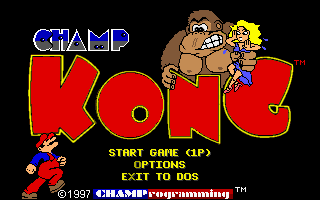
CHAMP Kong is a shareware platform video game developed and published by ChamProgramming Corporation for MS-DOS, released on February 13, 1996. The title is a fan remake of Nintendo’s classic 1981 arcade game Donkey Kong, faithfully recreating its core gameplay while adding new content and configurable options for home computer players. It was part of a series of arcade remakes by ChamProgramming, which included adaptations of other early arcade classics.
In its primary “Classic” mode, CHAMP Kong closely emulates the original Donkey Kong experience: the player controls Jumpman as he ascends multiple vertically-oriented levels by running, jumping, and climbing ladders while dodging barrels and fireballs thrown by the titular ape. The objective remains rescuing his girlfriend Pauline — represented as a damsel in distress at the top of each construction site — a defining premise carried over from Nintendo’s influential platformer.
Beyond the Classic mode, CHAMP Kong includes an enhanced “Champ” mode, featuring redesigned levels, additional bonuses, and more complex challenges. This expanded mode offers a variation on the original structure while retaining recognizable elements such as scoring items and hazard patterns, giving players both a nostalgic experience and fresh content. Inputs can be mapped to keyboard, joystick, or mouse, and the game provides multiple difficulty settings and an adjustable game speed to suit different play styles.
In retrospective assessments, CHAMP Kong is generally viewed as a well-crafted homage rather than an official Nintendo product, appealing primarily to enthusiasts of retro arcade gameplay on DOS systems. Community reviews tend to note the faithful recreation of Donkey Kong’s mechanics and level flow, though opinions vary on the Champ mode’s value compared to the original.
CHAMP Kong exemplifies the 1990s shareware culture in which small teams produced computerized remakes of beloved arcade titles, packaged with extras such as high score tables and customizable controls. It sits alongside other fan-driven reimaginings of arcade classics and illustrates how early platform games like Donkey Kong continued to inspire independent developers years after their debut.